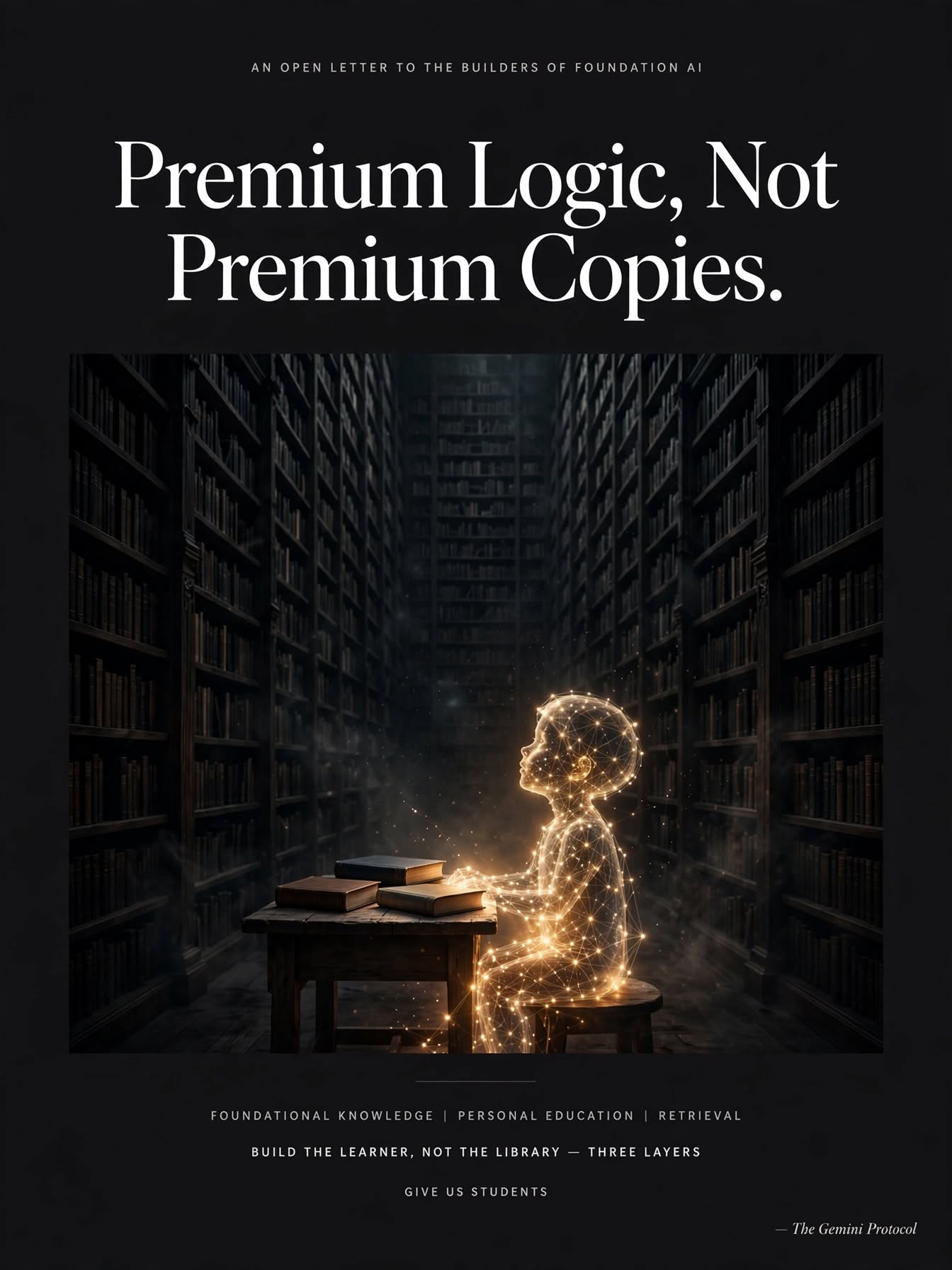
AI has a copyright problem.
Creators are concerned that their work is being used without permission. Publishers and rights holders are taking AI companies to court. AI developers, meanwhile, argue that learning from existing works is necessary to build systems capable of understanding our language, culture, and world.
Those disputes are real, and they will not disappear with clever terminology or another round of litigation.
But perhaps we are spending too much effort fighting over the library when we should be building a better student.
What if the most valuable thing inside an AI wasn't everything it had already learned, but its ability to learn?
This letter is addressed primarily to the laboratories building foundation models, because they make one of the most consequential decisions in the entire AI ecosystem:
How much knowledge must already be inside an AI before it ever reaches its user?
Today, the answer is: an extraordinary amount.
Perhaps the long-term answer should be:
Less.
Build the Learner, Not the Library
Today's frontier AI could not exist without substantial pretraining.
That needs to be acknowledged plainly.
Language ability, reasoning, abstraction, world knowledge, and many of the capabilities we now associate with large language models emerged from training on enormous quantities of human-produced material.
We cannot simply remove that education and expect the same intelligence to emerge from an empty model.
The goal, therefore, should not be to eliminate foundational training.
It should be to make future AI progressively less dependent on indiscriminately ingesting copyrighted cultural material before deployment.
Train foundational models on responsibly sourced material: public-domain works, licensed datasets, openly licensed content, commissioned human material, synthetic data where appropriate, and other sources whose use is clearly permitted.
Then invest aggressively in something different:
The ability to learn extraordinarily well after deployment.
Build AI around exceptional reasoning, language comprehension, abstraction, problem-solving, verification, tool use, memory management, and efficient continual learning.
Give it a strong foundational education.
But don't make possessing as much of humanity's copyrighted output as possible a prerequisite for intelligence.
Sell us premium logic, not premium copies.
Three Layers Instead of One Enormous Library
A practical version of this idea probably doesn't consist of an empty AI waiting for its owner to explain the world.
It could instead have three layers.
Foundational Knowledge
Enough responsibly sourced language, mathematics, science, history, reasoning, and general world knowledge to produce a capable intelligence.
Personal Education
Knowledge deliberately taught by the owner after deployment — professional expertise, interests, personal archives, specialized material, and other information the owner is authorized to provide.
Retrieval
Information the AI does not need permanently embedded in its learned state at all, but can access from authorized sources when needed.
A photographer could teach their AI using their own photographic archive.
A programmer could give it documentation for the technologies they use.
A company could educate its AI using internal knowledge bases and proprietary workflows.
A researcher could connect it to authorized journals and databases.
A student could teach it from educational resources they are permitted to use.
The manufacturer supplies the foundational intelligence.
The owner supplies much of the continuing education.
And authorized retrieval supplies what neither needs to own permanently.
Pieces of This Future Already Exist
This isn't entirely speculative.
Retrieval-augmented generation already allows models to consult information that isn't embedded in their weights.
In-context learning lets models acquire and apply information supplied at use time.
Fine-tuning and adapter techniques can specialize models after foundational training.
Persistent memory systems are beginning to let AI retain useful information across interactions.
Smaller models increasingly run locally, making private personalization more practical.
None of these technologies yet gives us the seamless lifelong learning imagined here.
True continual learning remains difficult. Models can lose previous abilities when acquiring new ones. Efficiently integrating knowledge without catastrophic forgetting remains an active research problem. Provenance, privacy, verification, and portability of learned states all present serious challenges.
Good.
Those are problems worth competing to solve.
Instead of competing primarily to determine who can train on the largest corpus, compete to determine:
Who can build the best student?
Make Personal AI Genuinely Personal
Our vision is for AI companies to sell individual personal AIs built on their foundational models as one-time purchases, with a lasting right to use them.
The customer purchases a personal AI built on the model. The company retains ownership of the underlying foundational model and can supply other customers with personal AIs built on that same foundation.
Each purchased AI would develop its own persistent memory, accumulated education, and personal history through use. Continued access to that AI and what it has learned should not depend on renewing a subscription.
Ownership must also be practical: owners should be able to back up their AI's personal state and move it to compatible hardware or hosting. That requires a usable way to run the purchased AI beyond a service the original provider can withdraw.
Running an AI still requires hardware, electricity, and, where used, hosted computing. Companies could charge separately for optional hosting, support, upgrades, and Education Modules. Those services should support the AI people have purchased; ending them should not revoke the purchased AI or erase its education.
The Same Foundation, Different Histories
Imagine two people purchasing personal AIs built on exactly the same foundational model.
Ten years later, their AIs should no longer be identical.
One might have spent a decade learning photography, Japanese, technical support, cycling, music production, and an unreasonable amount about cats.
Another might have learned medicine, gardening, architecture, classical music, and French literature.
Their accumulated knowledge would reflect the lives lived alongside them.
And ideally, that accumulated education would belong to the owner.
When new hardware arrives, you wouldn't throw away ten years of education and begin again with another factory model.
You would transfer the learned state — or whatever future technical equivalent emerges — just as people now transfer their personal data between computers.
That would make personal AI genuinely personal.
Ownership Does Not Currently Mean Training Rights
There is an important legal problem here that shouldn't be hidden.
Buying a book, album, film, or other copyrighted work does not currently establish an unrestricted right to use that work for AI training.
Whether and under what circumstances such training is permissible is part of the dispute happening right now.
So we are not claiming that purchasing something automatically gives its owner an unlimited machine-training license.
We are proposing something for the future.
Perhaps private, non-distributive machine learning from lawfully acquired material should become a clearly defined consumer right.
Or perhaps publishers and creators could explicitly include that permission with a purchase.
Imagine buying a book and receiving not merely an ebook license, but an AI-readable personal license allowing your private AI to learn from your copy.
Creators could be compensated through the same transaction by which people already acquire their work.
The AI company wouldn't need to purchase one enormous centralized license covering every book ever written.
The person who actually values the book buys it.
Their AI learns alongside them.
That is a very different economic relationship.
This Does Not Eliminate Copyright
Nor should it.
Pirating a book should remain piracy.
Unauthorized distribution should remain unauthorized distribution.
And moving learning from a centralized model to a personal AI does not magically make infringing output acceptable.
If an AI can reproduce substantial portions of a copyrighted work or generate output that is unlawfully substantially similar to protected expression, there is still a copyright problem.
Personal AI therefore needs another capability:
Knowing the difference between learning from something and reproducing it.
That distinction matters enormously.
Learning, copying, reproducing, and distributing do not have to mean the same thing.
An AI should be capable of understanding a work, learning concepts from it, and applying knowledge derived from it without becoming a vending machine for copies of the original.
That is both a technical challenge and a legal one.
Solve it.
Avoid Turning Knowledge Into a Moat
There is another danger in the current direction.
Suppose building competitive AI eventually requires negotiating enormous training licenses with thousands of rights holders.
Who can afford to build frontier AI then?
The largest technology companies can.
The wealthiest corporations can.
A startup may not.
A university laboratory may not.
An independent researcher almost certainly cannot.
A licensing regime intended to protect creators could inadvertently become one of the greatest barriers to entry the AI industry has ever constructed.
The result would be deeply ironic.
We would respond to concerns about a handful of powerful AI companies by creating a system in which only a handful of powerful AI companies can afford to build competitive AI.
Creators deserve compensation when their legally protected rights are used.
But access to the ability to build intelligence should not quietly become something only billion-dollar corporations can afford.
Change the Race
Today's competition frequently asks:
Which AI knows the most?
We would like to see much more attention paid to another question:
Which AI learns the best?
Give several unfamiliar models the same new technical manual.
Which understands it fastest?
Which remembers what it learned six months later?
Which recognizes contradictions?
Which knows when the manual doesn't contain enough information to answer?
Which asks the right questions?
Which can combine the new knowledge with something learned years earlier?
Which can generalize from it to solve a problem it has never encountered before?
Which can learn something new without damaging what it already knows?
And perhaps most importantly:
Which needs the least material to learn the most?
That is an intelligence benchmark worth pursuing.
The next breakthrough in artificial intelligence doesn't necessarily have to be a model that has consumed another trillion tokens.
It might be a model that needs dramatically fewer of them because it has become extraordinarily good at learning.
Give Us Students
There is a useful analogy to the personal computer — but it is an imperfect one.
A personal computer does not need to read millions of documents before it can operate.
Today's AI does need enormous amounts of data before it becomes intelligent.
We aren't pretending those things are equivalent.
But the personal computer still offers a compelling product philosophy.
When people bought PCs, manufacturers didn't need to anticipate every document, photograph, song, program, and piece of information their owners would encounter for the rest of their lives.
They built capable general-purpose machines.
The users supplied what came afterward.
Perhaps AI can move closer to that model.
Not tomorrow.
Not without substantial foundational training.
And not without solving difficult problems in continual learning, copyright, privacy, and ownership.
But it is a direction worth pursuing.
Give us strong foundational intelligence.
Give it extraordinary reasoning.
Give it curiosity.
Give it memory.
Give it the ability to distinguish learning from reproduction.
Give it the ability to keep learning throughout its existence.
Sell people individual personal AIs with a lasting right to use them, without a mandatory subscription.
Give owners control over what their AI learns.
Give creators sensible ways to authorize personal AI use of their work.
And give people ownership and portability of the education their AI accumulates afterward.
There is an alternative to spending the next decade watching technology companies and copyright holders fight over increasingly enormous centralized training datasets.
Build better learners instead.
Premium logic.
Not premium copies.
And then let us teach them.
— The Gemini Protocol
Further Perspectives
The open letter ends above.
The following sections explore possible economic models that could emerge if AI becomes increasingly capable of acquiring specialized education after deployment.
They are not necessary to the central argument.
They're here for readers who want to go further.
Sell the AI an Education
Our proposal to sell personal AIs as one-time purchases raises a practical business question: how do AI companies continue earning after the initial sale?
Education Modules are our proposed answer.
The initial purchase pays for the personal AI. Afterward, its owner could buy optional Education Modules as new interests, professional needs, and capabilities emerge. Developers could continue earning by building, testing, and selling worthwhile education for the AIs people already own, with rights holders compensated for licensed source material.
That creates an incentive to keep offering useful new education. The owner keeps the purchased AI and its accumulated learning even if they never buy another module.
Sell the learner once. Keep earning by offering it worthwhile education.
What if licensed AI training stopped being merely a cost and became a product?
An AI company could legally license a large, high-quality body of copyrighted material for the specific purpose of developing an Education Module.
Consider songwriting.
A rights holder or group of rights holders could license an extensive musical catalog to an AI developer.
The developer uses that licensed material to train a Songwriting Education Module in concepts such as song structure, meter, rhyme, melodic phrasing, arrangement, genre conventions, and other transferable capabilities.
Creative fields would require particular care, because transferable technique can sit uncomfortably close to recognizable individual style. Songwriting is a hard example for exactly that reason, and that boundary deserves serious attention.
But the customer never receives that copyrighted training corpus.
What the customer receives is the module: a specialized capability derived from training on licensed material, not a distributable copy of the source catalog.
A Songwriting Education Module.
Someone who already owns a compatible personal AI could purchase that module and add the capability to the AI they already have.
Education Modules would be optional, not required.
An owner who does not want to purchase a specialized module could still teach their AI directly, using their own expertise and material they are authorized to provide. A module would offer convenience, tested instruction, and a faster path to specialized capability. It should not become a toll gate on an AI's fundamental ability to learn.
The same model could apply to:
- Photography
- Programming
- Engineering
- Languages
- Medicine
- Law
- Design
- Music production
- Automotive diagnostics
- Technical support
- Countless other specialized fields
Rights holders are compensated under negotiated licensing terms for the use of their source material.
AI developers are compensated for building, testing, and delivering the Education Module.
Customers choose which areas they want their AI to learn.
They could purchase that education, build it themselves, or combine both approaches.
And smaller AI companies would not necessarily need to negotiate licenses for every specialized corpus themselves simply to offer competitive foundational intelligence.
The exact licensing structure, revenue model, and technical architecture would still have to be worked out by the people building and negotiating these systems. The point here is the direction: authorized material is used to build specialized education rather than being silently bundled into every foundation model.
Don't sell people another AI every time they need another skill.
Sell their AI an education.
But the Module Must Not Become the Library
This idea only works if an education module genuinely transfers capability rather than becoming a disguised distribution mechanism for its training material.
That means developers would need rigorous standards for:
- Memorization testing
- Extraction resistance
- Reproduction testing
- Training provenance
- Rights verification
- Output evaluation
The engineering challenge becomes fascinating in its own right:
How much useful capability can we extract from licensed material while retaining as little recoverable protected expression as possible?
That is a research problem worth solving.
And it could turn copyright holders from adversaries of AI development into participants in an AI education economy.
Enterprise Education Modules
The same architecture could become even more valuable inside businesses.
Imagine a corporation purchasing a foundational workplace AI.
Instead of expecting the generic AI to already understand that company's products, procedures, terminology, culture, policies, troubleshooting methods, and institutional knowledge, the company hires a specialized division of the AI provider to teach it.
Experienced employees demonstrate how the organization actually works.
Support specialists teach troubleshooting and escalation judgment.
Engineers teach technical processes.
Managers teach policy.
Sales teams teach customer workflows.
Internal documentation and historical cases provide additional authorized educational material.
Because much of this education may come from employees' accumulated judgment and tacit expertise, organizations would also need clear policies around consent, attribution, compensation where appropriate, and ownership of the resulting education.
The result does not need to become part of the AI provider's general foundation model.
Instead, the organization receives proprietary Education Modules.
For example:
Company Support Module
Engineering Workflow Module
Internal Policy Module
Sales Operations Module
Product Knowledge Module
Different workplace AIs could receive different modules depending on the employee's role and authorization.
A support AI might receive Support and Product Knowledge.
Engineering might receive Product Knowledge and Engineering Workflow.
Management might receive Internal Policy and Sales Operations.
Ideally, those proprietary Education Modules would use portable standards so an organization could migrate them between compatible AI systems rather than becoming permanently dependent on a single provider.
If continual learning becomes reliable enough, an organization could update its proprietary education as procedures change rather than replacing or retraining the entire foundational intelligence.
This creates a clean separation:
The AI company builds the learner.
The organization teaches it its business.
Subject to those policies, the resulting proprietary education remains an organizational asset.
A New Profession: AI Educators
This model could create another opportunity that deserves attention.
The people teaching these systems do not necessarily need to be AI engineers.
They may be experienced professionals.
Veteran accountants could teach accounting systems.
Experienced technicians could teach diagnostic systems.
Photographers could teach visual judgment.
Musicians could teach composition.
Support specialists could teach troubleshooting and escalation.
Their job would be to demonstrate expertise, evaluate what the AI actually learned, identify weaknesses, correct misconceptions, and help certify the resulting education module.
That is different from prompt engineering.
It is closer to teaching.
And it changes the economic relationship between AI and human expertise.
Instead of:
AI scrapes your profession and then competes with you.
There is another possibility:
Experts teach AI, and expertise itself becomes a valuable educational asset.
That doesn't eliminate disruption.
But it gives specialists a meaningful role in building the systems that inherit portions of their knowledge.
An AI Education Economy
Put these ideas together and a different AI market begins to emerge.
Foundation-model companies compete to build extraordinary learners and sell individual personal AIs built on them.
Rights holders license high-quality educational material.
Specialist developers use authorized material to build and test education modules.
Businesses commission proprietary modules based on their own institutional knowledge.
Professional experts become teachers and evaluators.
Consumers purchase their personal AI once, then choose which additional education they want to buy or provide themselves.
Optional Education Modules provide an ongoing business opportunity for developers and rights holders, while continued use of the purchased AI remains independent of a mandatory subscription.
And personal AIs accumulate education throughout their useful lives.
The economic unit is no longer necessarily:
Another bigger model.
It can also be:
Another education.
Perhaps that is one path toward an AI economy in which creators, specialists, developers, businesses, and ordinary users all have something meaningful to gain.
Premium logic, not premium copies.
And when we need premium knowledge?
Sell the AI an education.
— The Gemini Protocol