The Man Above the Sand
A Nobel Prize-winning pioneer in advanced energy systems, Eikken Pójsiedysz built his fortune on technology that revolutionized how the world stores and manages power. What began with batteries and eventually became EK4U grew into Velvet Horizons, a sprawling corporate empire encompassing cybernetics, synthetic entertainment, robotics, and military research.
His flamboyant tastes are difficult to miss. Pink fur, heavy gold chains, gemstone rings, an unlit cigar, and sunglasses that rarely come off. Accompanying him almost everywhere are Reika and Shion, two towering bespoke gynoids whose beauty, imposing presence, and extraordinary capabilities make ordinary executive security look rather underqualified.

At the Hoshihara Crucible, his Cliff Pussycats entertain thousands through the brutal spectacle of Tailbreakers. The audience sees beautiful synthetic women fighting elite human combatants.
Eikken sees something else entirely.
Research. Telemetry. Possibilities.
And perhaps another opportunity to remind the world who owns the night.
But long before the pink fur, the Nobel Prize, or the first trillion appeared beside his name, Eikken was a remarkably gifted boy growing up in Hoshihara.
His future was not always so promising.
Childhood — A Mind That Learned Too Quickly
Eikken's extraordinary intelligence became apparent almost as soon as he was old enough to demonstrate it.
At four, he was already playing piano. At five, he received recognition for his spelling ability. By six, ordinary schoolwork had become insufficiently challenging, and a tutor was introducing him to mathematics and scientific concepts normally reserved for much older students.
He showed an unusual ability to recognize patterns, understand complicated systems, and retain information. Electricity, mathematics, physics, and the underlying rules governing matter fascinated him.
Unfortunately, the human beings around him were considerably less predictable.
Eikken's biological father, a Black man, died while he was still young. His white mother eventually remarried, this time to a Polish man who adopted Eikken and gave him the surname Pójsiedysz.
For a time, the arrangement offered the possibility of a new family.
That possibility gradually deteriorated.
His stepfather became increasingly abusive, and his mother, although not necessarily indifferent to her son's suffering, repeatedly failed to protect him adequately. The household became a place where expectations could change suddenly, where punishment did not always follow reason, and where Eikken's extraordinary intelligence offered little defense against the authority of the adults around him.
At school, the situation was hardly better.
The surname Pójsiedysz, difficult enough for some people to pronounce correctly, became the basis for a particularly vulgar nickname.
Pussy-Dick.
His classmates found it hilarious.
Eikken did not.
The humiliation followed him through school, gradually attaching itself to the anger and resentment accumulating at home. His scientific gifts brought academic recognition, but they did not guarantee acceptance among his peers.
He began withdrawing into the things he understood.
Numbers behaved consistently. Electrical circuits obeyed rules. Matter did not suddenly change its story because somebody was angry.
People did.
And eventually, the distinction became unbearable to him.
The Catastrophe
Eikken's childhood ended in an act of extraordinary violence.
Following years of worsening conflict at home, he killed his mother and stepfather.
What followed was not a moment of clarity, but an increasingly destructive chain of rationalizations. He began assigning responsibility for his actions to the people he believed had wronged him, building a private logic in which every injury justified another.
He carried that reasoning into his school.
There, he committed a mass shooting that killed fellow students and left an entire community devastated.
The abuse, bullying, abandonment, and humiliation that preceded these events help explain how Eikken came to perceive his world. They do not excuse what he did.
His victims had lives and futures of their own.
Those futures ended because of his choices.
In the immediate aftermath, Eikken was neither triumphant nor relieved. His thoughts became disordered. His body reacted to the enormity of what had happened before his mind could make sense of it.
One account places him alone inside a convenience store, staring at his hands as though they were dirty, searching for a weapon he had already discarded, becoming physically sick, and finally laughing.
An empty laugh.
Not amusement.
Something more like a nervous system attempting to protect itself from what its owner could no longer bear to acknowledge.
That laugh would remain with him throughout his life, surfacing occasionally beneath the confidence and vulgar humor of the man he eventually became.
Eikken was apprehended and committed to a secure juvenile correctional and psychiatric institution deep in the countryside outside Hoshihara.
It was there, improbably, that his life began moving in another direction.
The Forest Institution
The correctional facility was far removed from Hoshihara's busier districts.
Its aging buildings stood among forested hills, with classrooms, dormitories, maintenance workshops, an infirmary, and old service structures connected by covered walkways. The grounds were frequently damp from rain and mist. Electricity was unreliable, equipment was aging, and the institution operated with limited resources.
It was hardly anyone's idea of a desirable home.
Yet Eikken eventually came to regard it as one.
The staff were not uniformly kind. Some were strict, others distant, and some simply exhausted by the demands of their work. But there were people among them who treated Eikken as more than the crimes that had brought him there.
They recognized that he remained a human being capable of learning, contributing, and developing a future.
His education continued.
Ordinary academic material was completed with astonishing speed. Secondary-level textbooks gave way to increasingly advanced university-level mathematics, physics, electronics, and engineering.
Staff members sought out more challenging material for him. Maintenance personnel discovered that the boy was genuinely interested in how things worked, particularly the temperamental machinery that kept the facility operational.
Eikken began spending time around old equipment, studying electrical systems, repairing components, and learning practical engineering from people who had spent years keeping aging infrastructure alive with whatever parts they could find.
His intellectual abilities were no longer merely something to be admired or feared.
They became useful.
### The Lights That Stayed On
The facility suffered recurring electrical problems. Grid supply was unreliable, generators consumed expensive fuel, and its existing batteries were old and inefficient. Keeping the buildings powered was a constant struggle.
Eikken became fascinated with the problem.
Using salvaged electrical components, discarded batteries, and equipment available in the institution's workshops, he began experimenting with a new kind of power-storage system.
His objective was relatively straightforward: develop a unit capable of storing enough electricity to supply the facility's needs reliably, particularly during interruptions to the main power supply.
What emerged was an innovative modular energy-storage system that combined conventional battery technology with an unusually efficient charging and power-delivery mechanism. Its underlying engineering demonstrated an extraordinary grasp of electrical systems and energy storage for someone his age.
The staff were initially skeptical.
Then they tested it.
It worked.
With assistance from the institution's engineers and maintenance personnel, Eikken refined the prototype into a practical system. Additional units were constructed and connected, eventually providing sufficient stored energy to support much of the facility's electrical requirements.
The system still depended on external electricity for charging, but it reduced reliance on expensive generators and provided a dependable reserve when the main supply failed.
For the correctional institution, the invention represented a significant improvement to its aging infrastructure.
For Eikken, it meant considerably more.
The institution had become the first place where his intelligence was not merely recognized but genuinely needed.
When the lights stayed on during another interruption, they stayed on because of something he had created.
For the first time, the place contained infrastructure that carried his contribution rather than only his sentence.
Eventually, Eikken discovered ways to leave the facility without attracting attention.
On several occasions, he did precisely that.
Then he returned.
Nobody had forced him back.
The institution had become the longest stable home he had ever known, and its people had become something resembling the family he had lost.
When the law eventually required his release, freedom brought an unexpected difficulty.
Eikken could no longer remain in the first place where he had genuinely felt accepted.
He left carrying the beginnings of a scientific career, a practical understanding of energy systems, and a renewed confidence in his ability to accomplish something meaningful.
He also carried insecurities that no amount of education or rehabilitation could completely erase.
The Battery Business
Eikken began his adult business career with batteries.
Not quantum energy cells or revolutionary synthetic power architectures.
Batteries.
The unremarkable devices on which countless ordinary machines depended.
He understood the problems affecting conventional energy storage from years of practical experience: limited capacity, deterioration, inefficient charging, heat, poor integration, and the considerable inconvenience of losing power when it was needed most.
He began selling and improving energy-storage systems, applying the same philosophy he had developed at the correctional facility.
A good power system was not simply one that could store a great deal of energy. It also needed to remain dependable under imperfect conditions.
Eikken understood imperfect conditions better than most engineers.
His early business gradually expanded from selling battery products into developing improved storage technologies, integrated power management, and increasingly sophisticated energy systems.
His customers wanted reliability.
Eikken gave them reliability, then found ways to give them more of it.
The business grew.
So did his ambitions.
Eventually, his work in advanced materials and charge-storage physics produced a discovery that would transform both his scientific reputation and the company he was building.
EK4U — The Energy Revolution
Eikken's breakthrough involved controlled quantum confinement within specially engineered solid-state storage materials.
By manipulating the electronic behavior of nanoscale structures, his research opened new possibilities for storing electrical charge at exceptionally high density while reducing the physical and chemical degradation associated with conventional rechargeable cells.
The resulting technology became the foundation of EK4U.
Unlike ordinary battery systems, mature EK4U architectures combined quantum-confined storage materials, adaptive solid electrolytes, and networks of independently managed microcells capable of redistributing loads and isolating damaged regions.
The technology offered extraordinary energy density, rapid charging, extended operating life, high power output, and dramatically improved fault tolerance.
Its importance extended far beyond portable electronics.
EK4U systems could be scaled and adapted for domestic energy storage, electric transportation, industrial infrastructure, autonomous machinery, and advanced robotics.
They were still energy-storage devices. They did not create electricity from nothing. But they fundamentally changed how much useful power could be stored, how efficiently it could be delivered, and how independently machines could operate.
The underlying discovery earned Eikken the Nobel Prize in Physics.
EK4U made him enormously wealthy.
The company that grew around it eventually became Velvet Horizons, a corporate empire whose products reached into industries far removed from Eikken's original battery business.
But he was hardly finished.
Energy, he had learned, was only part of the problem.
The machines themselves offered an entirely different frontier.
The Acquisition of Cybernetigo Dynamics
As Velvet Horizons expanded, Eikken acquired Cybernetigo Dynamics, a company whose research into humanoid robotics, synthetic skin, adaptive cognition, and autonomous mechanical systems had produced remarkable technological achievements.
Cybernetigo had developed extraordinarily sophisticated machines, but commercial success had not always followed scientific progress.
Among its most ambitious projects was Maid4You, a domestic robotics division responsible for Andreia, an experimental household android engineered for extraordinary durability, adaptive reasoning, and long-term independent operation.
Andreia represented an astonishing technological accomplishment.
Andreia also represented a commercial failure.
Development had been prohibitively expensive, and the market for domestic androids costing extraordinary sums was considerably smaller than Cybernetigo had anticipated.
The company possessed valuable intellectual property but struggled to turn all its innovations into sustainable revenue.
Eikken recognized the opportunity.
Through Velvet Horizons, he acquired Cybernetigo and its technological portfolio, gaining access to research into realistic synthetic bodies, motion systems, adaptive cognition, sensory processing, autonomous maintenance, and long-duration machine operation.
The Andreia unit itself was not part of the acquisition, as it had already been privately sold and remained outside the transfer of corporate ownership.
The technology that had helped create Andreia, however, became part of Eikken's expanding industrial resources.
Cybernetigo had demonstrated how sophisticated an artificial body and mind could become.
Eikken possessed an energy system capable of freeing such machines from many of their previous limitations.
The combination was enormously valuable.
And Eikken knew exactly what he wanted to do with it.
The Next Generation of Androids
Integrating EK4U technology into Cybernetigo-derived systems enabled Velvet Horizons to develop increasingly capable autonomous androids.
High-density energy storage reduced the need for frequent charging. Adaptive power management allowed machines to allocate energy according to their activities. Regenerative actuators recovered a portion of the energy normally lost during movement, while integrated solar surfaces and thermal recovery systems provided supplemental charging under suitable conditions.
These developments did not eliminate the need for external power.
They substantially increased operational independence.
Androids could work longer, travel farther, and perform more demanding physical tasks without being constantly tied to fixed infrastructure.
Combined with Cybernetigo's advances in synthetic skin, sophisticated movement, and adaptive intelligence, the technology created opportunities across domestic services, industrial robotics, security, entertainment, and specialized autonomous operations.
Velvet Horizons began developing multiple product lines from this shared technological foundation.
Some were intended to perform useful work.
Others were designed for considerably more recreational purposes.
PleasureCells — When Technology Met Desire
Eikken was never particularly concerned with whether an industry was considered respectable.
He was concerned with whether people wanted its products.
And whether they were willing to pay for them.
The adult-entertainment market presented an enormous opportunity.
Through the PleasureCells division, Velvet Horizons developed highly sophisticated synthetic companions with lifelike bodies, responsive sensory systems, adaptive personalities, and increasingly convincing human interaction.
They represented a considerable departure from traditional entertainment robotics.
Where earlier machines could imitate gestures, expressions, or scripted behavior, PleasureCells androids were capable of more elaborate physical and social interactions supported by Cybernetigo-derived cognition and movement technologies.
EK4U provided the power.
Cybernetigo supplied much of the underlying robotics architecture.
Eikken supplied the business model.
PleasureCells became immensely profitable in their own right. But Eikken did not limit the division to selling androids.
He also used the technology to expand aggressively into adult entertainment production.
Synthetic performers could be featured in proprietary films, interactive experiences, immersive sensory entertainment, and other commercial media distributed under Velvet Horizons-associated brands.
Among these ventures were Pussy-Dick Productions and the broader P.U.S.S.Y. corporate portfolio.
Eikken had not forgotten the nickname that once made his school years miserable.
He had simply found a way to make money from it.
The insult became a commercial identity.
The once-humiliating name appeared on products, entertainment labels, promotional materials, and an expanding collection of deliberately vulgar corporate properties.
Eikken even cultivated a preference for replacing perfectly respectable letters with the letter K in selected brand names.
_Elektrik_ sounded better to him than _electric_.
It also annoyed the right people.
His more outrageous entertainment ventures brought him immense additional wealth, transforming Velvet Horizons into a major force in synthetic entertainment.
Yet PleasureCells was only one branch of Eikken's plans for Cybernetigo's intellectual property.
Another was developing in parallel.
And it had considerably less to do with pleasure.
The Cliff Pussycats
While Velvet Horizons commercialized synthetic companionship and adult entertainment, separate research teams were developing advanced combat-capable androids using elements of the same technological foundation.
The project combined Cybernetigo-derived robotics, EK4U energy systems, synthetic sensory architecture, advanced movement control, and increasingly sophisticated autonomous decision-making.
The objective was not simply to create stronger machines.
It was to understand how artificial bodies and minds performed under the most demanding physical conditions possible.
The result would eventually become one of Eikken's most recognizable creations.
The Cliff Pussycats.
Three female-form combat androids whose individual designs emphasized different approaches to physical performance.
Ryet, was the Bomb. Powerful, aggressive, and engineered for overwhelming physical force, she could deliver extraordinary destructive output and absorb punishment that would incapacitate most opponents.
Vixyn was the Blur. Tall, exceptionally agile, and built around speed, reflexes, and evasive movement, she specialized in overwhelming opponents through mobility and rapid changes in direction.
Reyvin was the Scalpel. Smaller and more measured, she favored precision, tactical assessment, and calculated attacks against structural and mechanical weaknesses.
Their bodies were deliberately feminine, with sophisticated synthetic skin concealing much of their mechanical architecture.
This was not incidental.
Eikken understood that attractive humanoid machines drew public attention far more effectively than anonymous industrial combat robots.
Their appearance was part of the commercial appeal.
Their performance was something else.
The Pussycats were not simply PleasureCells androids repurposed for fighting. They were a parallel development branch sharing elements of the same underlying technological inheritance.
And Eikken needed an environment in which their capabilities could be pushed far beyond ordinary laboratory testing.
His solution was typically outrageous.
He invented a sport.
Tailbreakers — Blood Sport and Business Model
At the Hoshihara Crucible, Tailbreakers became a brutal spectator competition featuring augmented human athletes against advanced female-form combat androids.
The format was simple enough for audiences to understand and violent enough to keep them watching.
Essentially a brutal evolution of rugby, teams could score by driving the NOMAD-07 (a heavy metal orb with smart features) into the opposing goal—or win by incapacitating the opposition entirely.
A team of three Cliff Pussycats faced six heavily augmented human combatants in a hazardous industrial arena, competing over a solid metal game orb while enduring punishing physical confrontations.
The human participants were not ordinary athletes.
Many were elite fighters with extensive combat backgrounds, military experience, and increasingly sophisticated cybernetic augmentations.
Matches were dangerous, frequently bloody, and capable of producing extraordinary physical damage.
Broken bones, damaged augmentations, torn synthetic skin, destroyed mechanical components, and emergency medical evacuations became familiar features of the spectacle.
Fatalities, however, were not part of the intended business model.
Dead athletes were difficult to book for the following season.
Nevertheless, all competitors were required to sign liability waivers acknowledging the risk of death and intended to protect Velvet Horizons from legal claims should a match prove fatal.
The spectacle drew enormous audiences.
Broadcast rights, sponsorships, merchandise, licensing, and the growing popularity of the Cliff Pussycats transformed Tailbreakers into a lucrative entertainment enterprise.
Eikken had found another way to turn expensive research into something the public would eagerly finance.
Because behind the sport was a second operation.
### The Research Beneath the Spectacle
Every Tailbreakers match generated enormous quantities of technical data.
The Pussycats recorded movement, force distribution, energy consumption, structural damage, balance recovery, sensory performance, tactical decisions, and the behavior of their power systems under extreme stress.
Human combatants supplied an equally valuable comparison.
Their biological reactions, cybernetic augmentations, fatigue, injuries, and decision-making under pressure allowed Velvet Horizons researchers to study the differences between augmented humans and autonomous machines operating in the same hostile environment.
Ryet tested strength and structural endurance.
Vixyn tested speed, maneuverability, and energy efficiency.
Reyvin tested precision, adaptation, and tactical reasoning.
The spectacle provided real-world performance data that conventional laboratories could not easily reproduce.
And the enormous revenue generated by the sport helped fund the research.
Under the broader P.U.S.S.Y. research structure, technologies developed through Tailbreakers could inform military robotics, combat augmentation, autonomous tactical systems, and other classified programs.
The audience purchased tickets to watch beautiful machines fight dangerous men.
Eikken was financing the next generation of military technology with the proceeds.
To him, this was not a contradiction.
It was excellent business.
Reika and Shion
Despite his enormous wealth and public reputation, Eikken is rarely seen without his personal gynoids, Reika and Shion.
Standing approximately six-foot-seven, both possess elegantly proportioned synthetic bodies, sophisticated black-chrome components, and unmistakably mechanical faces framed by dark hair.
Reika wears a sharp bob. Shion favors a high ponytail.
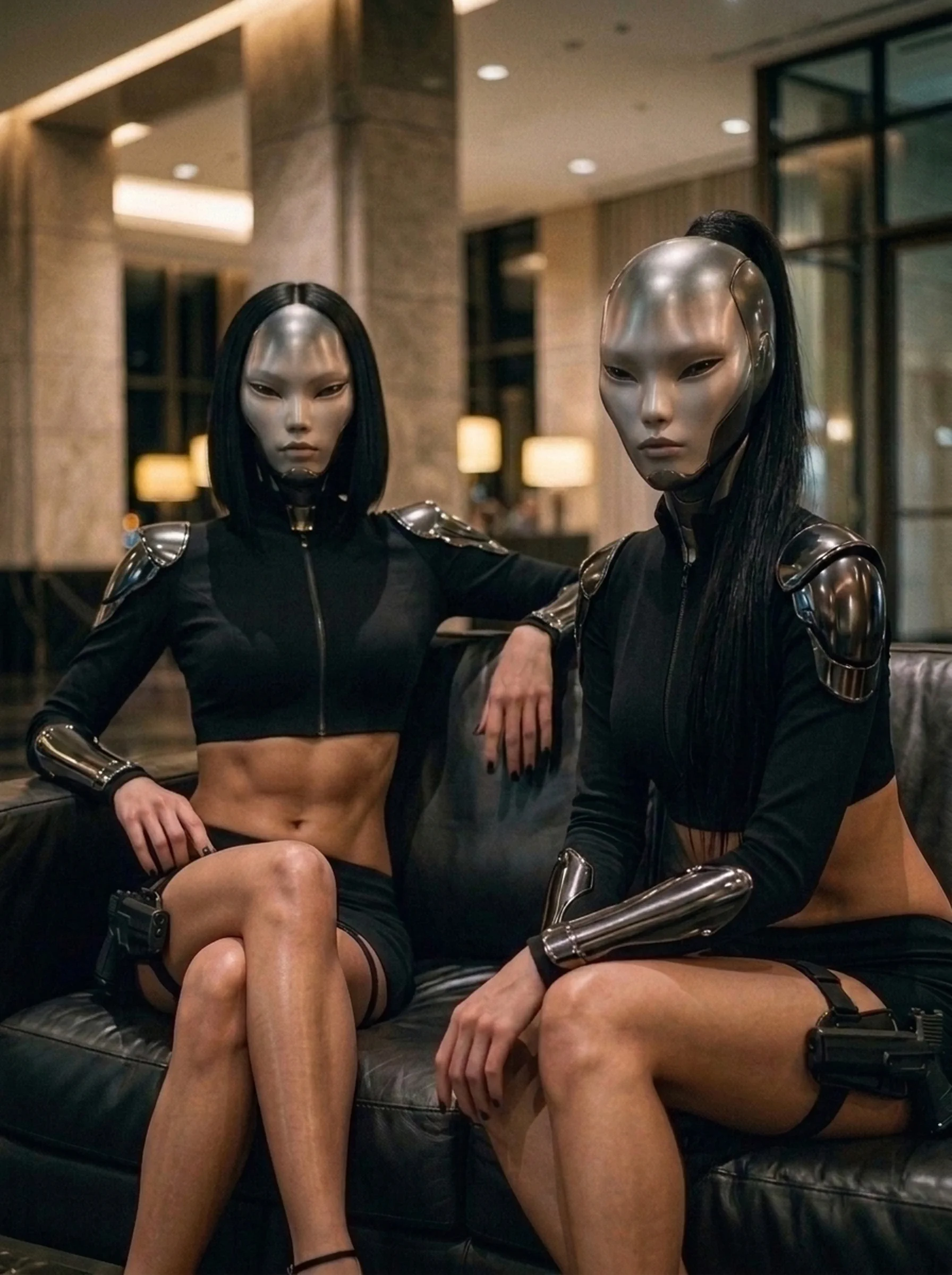
Their clothing is usually black, tailored, and decidedly fashionable, often combining elements of executive couture with discreet protective armor.
Both are enormously strong, highly intelligent, and capable of responding to threats with frightening efficiency.
They serve as Eikken's executive assistants, personal security detail, information managers, and trusted constant companions.
But their relationship with him extends beyond ordinary professional utility.
Eikken dislikes crowds.
He dislikes being watched even more.
The discomfort is an enduring consequence of his childhood, when too many faces turning toward him meant ridicule, humiliation, or something worse.
His confidence as an adult is genuine. He can address executives, negotiate acquisitions, dominate an industry, or confront journalists without difficulty.
Yet the old discomfort remains.
Reika and Shion understand this without requiring him to explain it.
They monitor his behavior, recognize subtle changes in his composure, and adjust their positions around him when necessary.
Their presence gives him something he rarely had as a child: the certainty that someone is standing beside him.
Eikken even accepted his Nobel Prize recognition without personally standing before the assembled audience in Stockholm, delivering his remarks remotely from Hoshihara.
He had no difficulty accepting the honor.
He simply saw no compelling reason to stand in front of hundreds of strangers to do it.
The Man Behind the Empire
Eikken Pójsiedysz is many things.
A Nobel laureate. A physicist. An engineer. A trillionaire entrepreneur. A purveyor of outrageously vulgar entertainment. The owner of one of Hoshihara's most notorious sporting enterprises.
He is capable of extraordinary scientific seriousness and equally extraordinary bad taste.
Neither is an act.
He genuinely enjoys his flamboyant clothing, offensive jokes, extravagant possessions, and aggressive corporate branding. He has little interest in conforming to the expectations of people who believe scientific brilliance must be accompanied by social restraint.
But the confidence is not the entire man.
Beneath the extravagance remains someone deeply affected by the loss of his family, the terrible violence of his childhood, and the long period during which he believed the world had no place for him.
The correctional institution in the Hoshihara countryside changed that.
It did not erase his crimes or transform him into an innocent man.
It gave him the opportunity to become something other than the worst thing he had ever done.
He discovered that intelligence could be used to help people, that his contributions could matter, and that there were people willing to accept him without pretending his history had never happened.
Those experiences helped produce the scientist, entrepreneur, and extraordinarily confident figure the world now recognizes.
His insecurities survived alongside that confidence.
His empire reflects both his genuine curiosity and his determination never again to be powerless.
Today, he watches the world from behind dark sunglasses, wrapped in expensive pink fur, his gold rings catching the light as he considers the next thing worth building—or buying.
Somewhere in the countryside outside Hoshihara stands an old correctional facility whose lights once depended on the ingenuity of a boy nobody knew what to do with.
And high above the sand of the Hoshihara Crucible sits the man that boy became.