The Sport That Shouldn't Have Worked
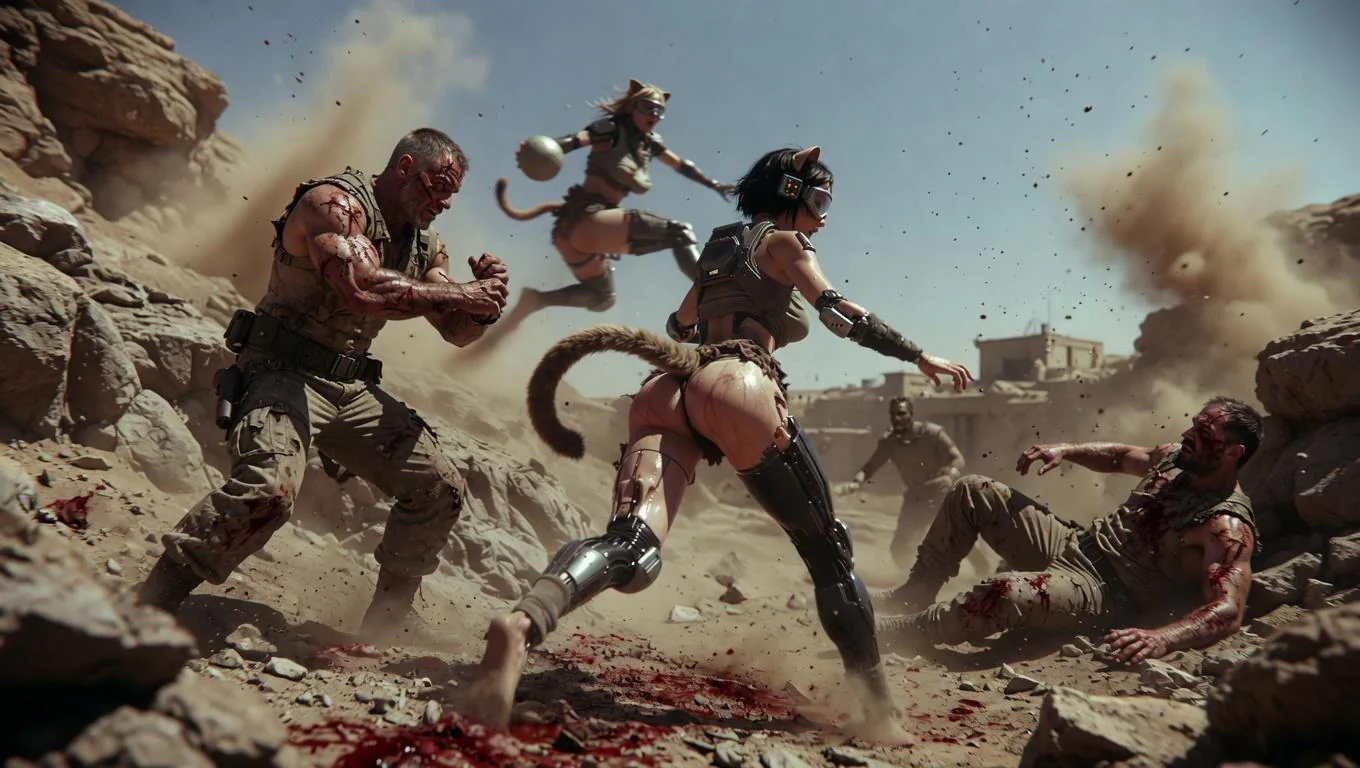
Tailbreakers is a professional combat sport originating in Hoshihara-shi, most famously associated with the Hoshihara Crucible and the Cliff Pussycats of Velvet Horizons.
Conceived by physicist and trillionaire industrialist Eikken Pójsiedysz, the sport began as an unconventional solution to a serious technological problem: how to test extraordinarily advanced combat machines against intelligent, adaptive opponents under conditions that no conventional laboratory could adequately reproduce.
Eikken's solution was to turn the experiment into a commercial spectacle.
Drawing its fundamental structure from rugby, Tailbreakers combines territorial competition, possession of a heavy metal game orb, physical confrontation, and tactical maneuvering through hostile terrain.
Its signature format pits three advanced female-form combat androids against six elite augmented human athletes.
The competitors may score by delivering the orb into the opposing goal or secure victory by rendering the opposing team incapable of continuing.
What appears to be an exceptionally violent sporting contest serves another purpose entirely.
Every match produces valuable information about strength, endurance, biomechanics, artificial intelligence, cybernetic augmentation, and decision-making under extreme physical stress.
The Crucible is simultaneously a sporting venue, an entertainment enterprise, and an experimental proving ground.
And unlike most research facilities, it sells tickets.
The Hoshihara Crucible
The Hoshihara Crucible is an enormous open-air arena built into Hoshihara's rugged industrial landscape.
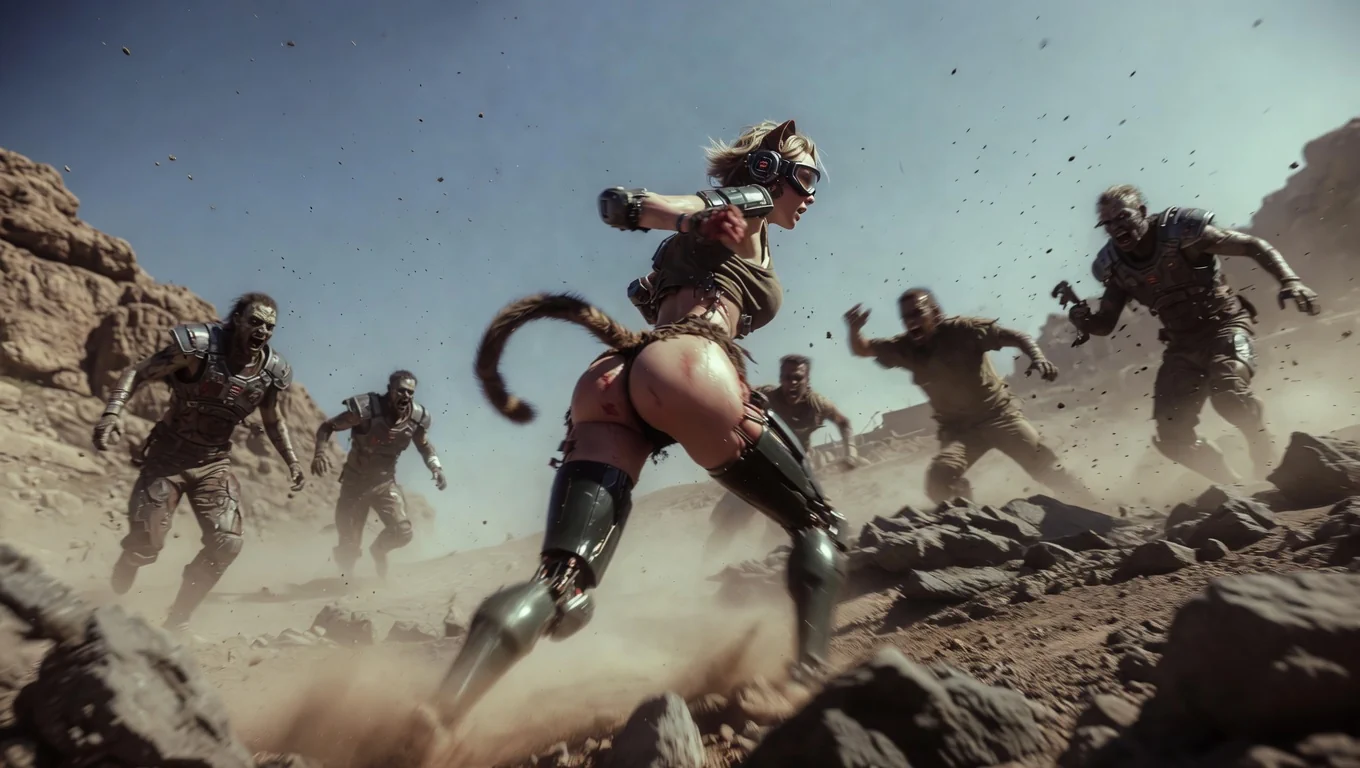
Its playing field retains the broad rectangular proportions of its rugby ancestry, but little else resembles a conventional stadium.
Sand and exposed rock dominate the terrain. Rusted industrial structures, ruined factory frameworks, reinforced scrap barriers, wrecked machinery, and broken concrete create obstacles and corridors across the field. Beyond the constructed battlefield, rocky cliffs and remnants of older development reinforce the Crucible's harsh, weathered character.
The environment is deliberately difficult.
Its obstacles complicate movement, visibility, pursuit, and tactical coordination. The uneven ground tests stabilization systems, impact recovery, mechanical durability, and the ability to maintain control of a heavy load while under attack.
Heat is another adversary.
Human competitors must contend with fatigue, dehydration, and the discomfort of protective equipment. Androids encounter their own problems: thermal regulation, actuator loading, power consumption, and the accumulation of mechanical stress.
At opposite ends of the arena, enormous Daylight Holo-Mesh displays present close-up footage, telemetry, replays, and scoring information to spectators.
High above the field sits the owner's box, where Eikken and his personal gynoids, Reika and Shion, can observe the competition through panoramic smartglass and private telemetry displays.
For the audience, the arena is a place of spectacle.
For its engineers, nearly every surface is part of an experiment.
The Basic Rules
Tailbreakers is a full-contact team competition built around possession and delivery of the NOMAD-07, a heavy metal orb equipped with integrated smart technology.
The sport's most recognizable format features three combat androids opposing six augmented human gladiators, although its fundamental principles concern teams competing for possession, territory, and control of the playing field.
The objective is straightforward: deliver the orb into the opposing goal.
A team may also win by incapacitating the opposition to the point that it can no longer continue.

Players may intercept, tackle, restrain, obstruct, and physically overpower their opponents. Unlike conventional rugby, the surrounding terrain is integral to the competition, and confrontations can be extraordinarily destructive.
Combat is not incidental to the sport.
It is one of its defining features.
However, the rules distinguish between legitimate physical confrontation and deliberate attempts to cause fatal injury.
Competitor fatalities are prohibited, although the nature of the competition means that serious injuries and accidental deaths remain possible.
Modern regulations also prohibit deliberately using NOMAD-07 to strike another competitor. This restriction applies equally to human and android teams.
The orb is the objective of the game, not a permitted weapon.
These restrictions do not make Tailbreakers a gentle sport.
Broken bones, damaged prosthetics, torn synthetic skin, destroyed actuators, dismembered mechanical components, and emergency medical evacuations are familiar features of its history.
All competitors acknowledge the risks through contractual liability waivers intended to protect the event's operators against claims arising from accidental fatalities and serious injury.
Survival is expected.
It is not guaranteed.
NOMAD-07 — The Weight of a Soldier
NOMAD-07 is the central object of competition and one of the sport's most important technological components.
Early versions were substantially lighter, allowing players to throw the orb at considerable velocity. Its integrated smart technology included magnetic rebound behavior that contributed to the sport's distinctive scoring mechanics.
As Tailbreakers matured, however, its purpose changed.
Velvet Horizons increasingly sought performance data relevant to military logistics, battlefield casualty recovery, and movement under hostile conditions.
The orb's weight was progressively increased until it approximated the mass of an adult soldier.
This transformation fundamentally altered the competition.
Carrying NOMAD-07 was no longer simply a matter of possession. A competitor now had to transport a substantial load while running, negotiating obstacles, evading opponents, absorbing impacts, and making tactical decisions.

The orb became a standardized representation of a casualty requiring evacuation from a dangerous environment.
It did not reproduce every physical complication of moving an injured human body. Instead, its consistent mass provided a demanding, repeatable basis for studying loaded movement under combat conditions.
The change also produced an important revision to the rules.
With NOMAD-07 now carrying approximately the weight of a soldier, deliberately throwing or driving it into an opponent became unacceptable.
The prohibition applies to both sides.
Its scoring-related rebound technology remains part of the sport's mechanical heritage, but no longer constitutes permission to use the orb as a projectile weapon against another competitor.
The heavier orb also changed the capabilities required of human athletes.
Ordinary human strength, even at an exceptional athletic level, was no longer necessarily sufficient for efficient performance.
Competitive human teams increasingly relied on cybernetic reinforcement, enhanced joints, powered musculature, load-bearing skeletal modifications, and other forms of physical augmentation.
A sporting requirement had created a technological arms race.
And the consequences extended far beyond the arena.
The Human Gladiators
The human competitors of Tailbreakers are among the most accomplished combat athletes in the world.
Many arrive with distinguished military backgrounds, extensive martial arts experience, special-operations training, or careers in other demanding combat disciplines.
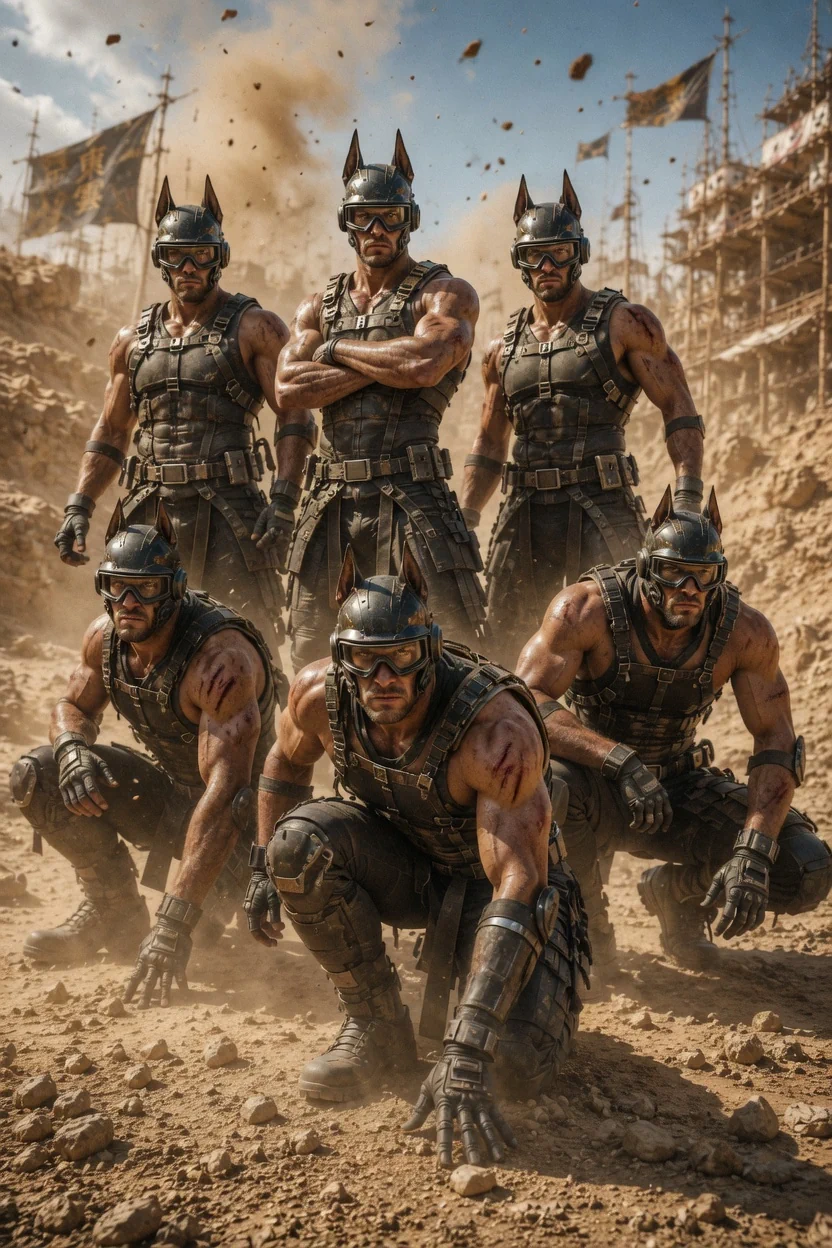
Others have already established themselves in professional fighting before entering the Crucible.
What distinguishes them is not simply their willingness to confront machines.
It is their ability to survive them.
A human team competing against the Cliff Pussycats must possess extraordinary physical conditioning, tactical coordination, technical competence, and psychological resilience.
Cybernetic augmentation may increase strength, speed, durability, or reflexes, but equipment alone does not produce a successful gladiator.
Human competitors must remain capable of judgment under pressure.
They must adapt to unfamiliar situations, recognize weaknesses, manage fatigue, coordinate with teammates, and recover from mistakes while facing opponents whose mechanical performance can exceed ordinary biological limits.
Their individual augmentations often reflect specialized responsibilities.
A heavily reinforced competitor may serve as the team's primary NOMAD-07 carrier, relying on strengthened spinal, pelvic, and lower-body systems to sustain the load.
Others specialize in grappling, intercepting, protecting the carrier, clearing routes, or exploiting openings in the opposing formation.
Successful teams integrate these capabilities rather than relying exclusively on individual strength.
The human gladiators are not anonymous victims assembled for the amusement of wealthy spectators.
They are celebrated professionals.
Any human who enters the Crucible and survives a serious contest against the machines earns a measure of legendary status, regardless of the result.
Those who return repeatedly become sporting icons.
A defeated human team can leave the arena to a standing ovation.
A competitor carried out on a stretcher may receive a louder cheer than the victorious androids.
For many spectators, the human gladiators are the true heroes of Tailbreakers.
They represent the extraordinary limits of biological humanity—and the technological determination to push beyond them.
The Cliff Pussycats
The most recognizable android competitors in Tailbreakers are the Cliff Pussycats, three female-form combat machines developed through Velvet Horizons' advanced robotics research.
They share elements of Cybernetigo-derived engineering, sophisticated autonomous cognition, synthetic sensory systems, and EK4U-based energy technology.
They are not PleasureCells androids modified for combat, although the two development branches share aspects of their technological ancestry.
The Pussycats were designed specifically for demanding physical performance.
Each represents a different research emphasis.
### Ryet — The Bomb
Ryet specializes in overwhelming force, physical power, and structural endurance.
Her performance provides valuable information about load-bearing capabilities, force distribution, impact resistance, and the ability to continue operating after significant mechanical damage.
Among the Pussycats, she is particularly suited to situations requiring brute strength and sustained physical confrontation.
### Vixyn — The Blur
Vixyn emphasizes speed, agility, acceleration, evasive movement, and efficient energy distribution.
Her design allows engineers to study rapid directional changes, high-speed stability, power management, and adaptation to difficult terrain.
Her ability to recover movement after physical disruption is especially valuable when assessing operational resilience.
### Reyvin — The Scalpel
Reyvin specializes in precision, predictive reasoning, tactical adaptation, and identifying exploitable weaknesses.
Her greatest value is not necessarily the force she can produce, but the efficiency and intelligence with which she applies it.
Reyvin's performance is particularly important to research involving autonomous tactical systems.
Together, the three Pussycats provide complementary data across strength, mobility, and tactical intelligence.
The most revealing results emerge when those capabilities must operate together.
Their femininity and carefully designed appearances are also commercially significant.
Eikken understood that sophisticated humanoid machines possessing recognizable personalities and attractive physical forms could command public attention far more effectively than anonymous industrial robots.
The public sees beautiful, dangerous women.
The engineering teams see three distinct approaches to the problem of artificial combat performance.
Both perspectives are commercially useful.
Corporate Sponsorship and the Augmentation Race
Although Velvet Horizons created Tailbreakers and remains closely associated with its most famous android competitors, it does not hold a monopoly on the technologies demonstrated in the arena.
Other corporations sponsor human gladiators and develop specialized equipment intended to improve their chances against the Pussycats.
For these companies, Tailbreakers provides something exceptionally valuable: a demanding public competition in which their technology can be evaluated against highly capable opposition.
Experimental prosthetics, reinforced skeletal systems, advanced protective equipment, enhanced sensory interfaces, powered exoskeletons, and other augmentation technologies can be tested under conditions far more punishing than ordinary demonstrations.
A successful innovation may deliver a decisive advantage to a sponsored athlete.
It may also attract lucrative customers outside professional sport.
Military organizations require equipment capable of improving strength, load transportation, mobility, injury resistance, and operational endurance.
Paramilitary and specialized security organizations may seek similar capabilities.
Emergency-rescue operations also benefit from equipment that allows personnel to move heavy loads, navigate unstable environments, and extract injured people from dangerous locations.
In this sense, the technological competition is not limited to Velvet Horizons against its human opponents.
The Crucible brings multiple research and development interests into direct competition.
Each sponsor wants its athletes to perform better.
Each manufacturer wants its equipment to demonstrate superiority.
And each successful innovation can become commercially valuable far beyond Tailbreakers.
The sport is therefore both an athletic competition and a marketplace for advanced human augmentation.
The Military Research Connection
The most important function of Tailbreakers may be the one least visible to ordinary spectators.
Every match generates extraordinary quantities of technical and behavioral information.
For Velvet Horizons, the Cliff Pussycats provide detailed records of actuator performance, structural damage, energy distribution, sensor interpretation, balance recovery, movement efficiency, and autonomous tactical decision-making.
Their human opponents provide a different kind of information.
Biological fatigue, physical injury, cybernetic reinforcement, tactical improvisation, pain responses, and performance under extreme stress can all be studied alongside the behavior of advanced artificial bodies.
This creates a comparison between two different approaches to physical capability: engineered machinery operating autonomously and biological humanity enhanced through technology.
The heavier NOMAD-07 adds another dimension.
It allows engineers to study what happens when participants must preserve mobility and tactical effectiveness while transporting a casualty-equivalent load.
A competitor may be exceptionally fast when unencumbered but much less capable while carrying the orb.
Another may possess tremendous strength but lack the endurance or coordination to transport it efficiently through obstacles and hostile opposition.
A successful design must reconcile these competing demands.
The resulting research has potential applications in military robotics, combat augmentation, tactical systems, emergency evacuation, and battlefield casualty recovery.
Under the broader P.U.S.S.Y. research structure, information gathered through the Cliff Pussycats also contributes to classified programs, including research relevant to the development of C.A.A.T.s.
The transfer concerns knowledge, performance analysis, biomechanics, and tactical principles—not the literal transplantation of mechanical android components into biological operatives.
The Crucible allows these technologies and concepts to be examined through repeated encounters with unpredictable opposition.
An android may win a match while revealing serious mechanical weaknesses.
A human team may lose while demonstrating an exceptionally effective augmentation.
A failed tactical prediction can be more informative than a successful attack.
From the perspective of the research teams, victory is only one measurement among many.
Risk, Reputation, and Survival
Tailbreakers occupies an uncomfortable position between professional sport and organized violence.
Its competitors voluntarily participate, often for substantial compensation, sponsorship opportunities, professional prestige, and the possibility of extraordinary financial rewards.
Yet the dangers are considerable.
Human athletes face potentially permanent injury, failed augmentations, and life-threatening trauma.
Combat androids may sustain extensive structural destruction, including the loss of limbs, sensors, and other essential components.
The rules prohibit fatalities, and medical intervention forms part of the competition's operational requirements.
Nevertheless, the possibility of death remains an acknowledged risk.
That reality contributes to the sport's reputation.
Spectators recognize that the human gladiators are undertaking something beyond conventional athletic competition.
A fighter who survives a confrontation with the Pussycats has achieved something remarkable, even without scoring a point.
Repeated appearances create reputations that can endure beyond an athlete's competitive career.
These survivors become celebrities, commercial representatives, and sometimes symbols of the technologies that kept them alive.
The machines attract enormous attention.
But the human competitors give the audience someone to identify with.
It is one thing to marvel at a powerful android.
It is another to watch a human being stand up after that android has knocked him down.
The Business of Blood Sport
Tailbreakers generates revenue through ticket sales, broadcasting rights, commercial sponsorships, licensing, merchandise, and the celebrity status of its competitors.
The Cliff Pussycats are particularly valuable commercial properties, attracting spectators interested in both their extraordinary capabilities and their distinct personalities.
Human gladiators generate their own followings.
Corporate sponsors compete for visibility.
Manufacturers gain opportunities to demonstrate their products under extreme conditions.
Broadcasting adds another dimension to the spectacle.
At the Hoshihara Crucible, enormous display systems ensure that even distant spectators can follow the action, while live camera feeds, drone footage, telemetry, and instant replays provide perspectives impossible to appreciate from the stands alone.
The broadcasts are also known for their unusually irreverent commentary.
The Crucible's two famously foul-mouthed commentators have developed a following of their own, blending technical knowledge of the sport with relentless banter, profanity, and occasional Japanese expressions.
Their tendency to forget that their microphones are live has become a recurring source of amusement for spectators.
Eikken himself has heard the routine enough times that another accidental open-mic exchange generally earns little more than a slight shake of his head.
He does not particularly mind.
The audience enjoys it.
And the audience pays.
That arrangement summarizes much of Eikken's commercial philosophy.
Beyond the Crucible
Tailbreakers has evolved far beyond its original purpose as a public testing environment for advanced combat androids.
The progression from a lighter, high-velocity game orb to the casualty-equivalent NOMAD-07 illustrates the sport's changing technological priorities.
Its human competitors have become increasingly augmented.
Their sponsors have developed increasingly sophisticated equipment.
The androids continue to improve through experience, failure analysis, and engineering refinement.
Military and civilian applications emerge from technologies first tested for competitive advantage.
Meanwhile, the sport continues to produce legends.
Its most successful human competitors demonstrate that exceptional individuals, supported by increasingly advanced technology, can challenge machines designed to surpass ordinary human physical limits.
Its android competitors demonstrate the extraordinary possibilities of autonomous artificial bodies.
Neither side exists merely to make the other look impressive.
Their opposition gives the competition meaning.
For the spectators, Tailbreakers remains a brutal, thrilling contest between some of the most capable humans and machines in the world.
For the corporations, it is a technological proving ground.
For its gladiators, it can mean fortune, fame, permanent injury, or an early grave.
For Eikken Pójsiedysz, it is something characteristically more complicated.
A sport.
A business.
A laboratory.
A technological arms race.
And a particularly profitable way to find out what happens when extraordinary machines meet extraordinary people.
Three against six.
One very heavy orb.
And nowhere to hide.