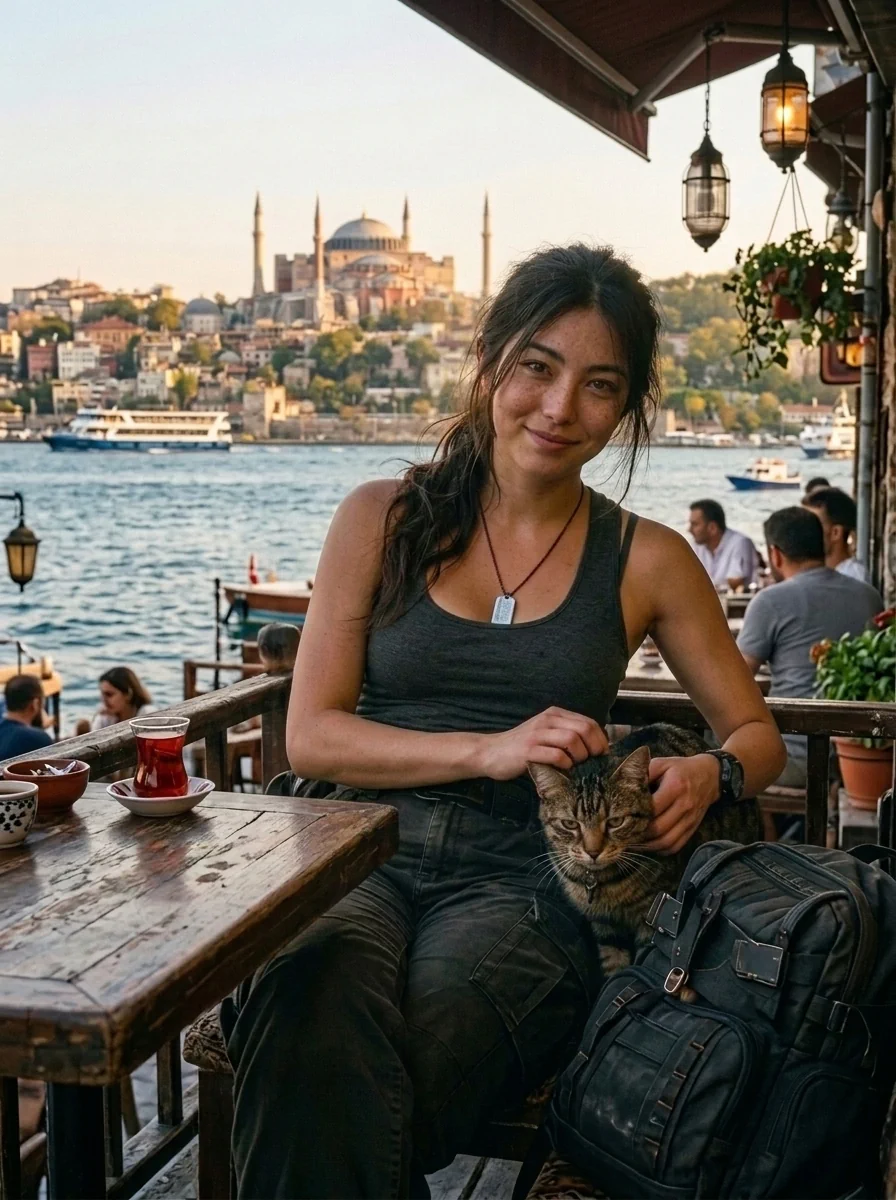
Tanya D'Gaul is a former U.S. Marine who later completed BUD/S and served with DEVGRU (SEAL Team Six). She eventually moved into CIA black operations, building a career around infiltration, direct action, unconventional warfare, and missions that officially never happened. She was selected as the human reference model for Specimen 9 precisely because Velvet Horizons was not looking for an average human template. It wanted a proven one.
Her genetic material served as the human template from which parts of the Specimen 9 lineage were developed.
The Woman Before the C.A.A.T.s
Veteran operative. Prototype field tester. The human legacy behind Specimen 9.
Before the C.A.A.T.s became one of the most formidable combat programs of their era, there was Tanya D’Gaul.
She was not genetically engineered for war. She possessed neither the enhanced physiology of the later commandos nor their sophisticated sensory architecture. What she had was something no laboratory could manufacture from scratch: decades of operational experience, exceptional discipline, and an instinct for survival sharpened by situations in which the smallest mistake could be fatal.
Long before her name became associated with an extraordinary military biotechnology program, Tanya had already earned a formidable reputation of her own.
A Career in the Shadows
Tanya's operational history traces a path through some of the most demanding institutions of American military and intelligence service.
Her background includes service with the United States Marine Corps, subsequent completion of BUD/S, service with DEVGRU, and eventually involvement in CIA black operations.
Much of her professional life remains obscured by classified assignments, compartmentalized records, and the deliberate disappearance of operational histories.
She became accustomed to working alone, often in environments where institutional support could not be counted upon and extraction was never guaranteed.
Her reputation was built not simply on her ability to fight, but on her ability to recognize when fighting was unnecessary.
For Tanya, tactical superiority has never meant killing the greatest number of enemies. It means accomplishing the objective, preserving operational freedom, and ensuring that the people who enter a mission have the best possible chance of leaving it.
She is neither a pacifist nor an idealist. She will use lethal force when circumstances demand it. What she refuses to accept is unnecessary violence masquerading as professional competence.
_Observe first. Strike if the strike matters._
The Prototype Years
Tanya's association with C.A.A.T.—Cybernetics, Assault, and Tactics—began through her work testing experimental combat equipment.
Long before the streamlined systems issued to later generations of operators, there were heavier, more temperamental prototypes. Experimental armor assemblies, adaptive sensory interfaces, advanced visors, and powered mobility systems had to be proven under realistic operational conditions.
Tanya became one of the people willing—and sufficiently qualified—to take those systems into the field.
Her experimental equipment was not always elegant. Early configurations were bulky, sometimes asymmetrical, and frequently carried hardware that subsequent production models would conceal or eliminate.
But every imperfection revealed something valuable.
A delayed response during a climb. Excessive thermal accumulation during sustained exertion. A poorly positioned sensor. An actuator that worked perfectly in a laboratory but interfered with natural movement under combat stress.
Tanya's field evaluations translated these failures into practical improvements.
Importantly, the machinery belonged to her equipment, not her anatomy. Tanya remained a flesh-and-blood human being, with natural arms, hands, and limbs. Limited augmentation was possible, but she was never the visibly mechanical soldier that some experimental suit designs suggested.
She helped establish the operational foundation upon which the next generation would be built.
The Human Foundation of Specimen 9
Tanya's contribution eventually extended far beyond testing combat hardware.
Within the restricted research architecture of Velvet Horizons, her genetic material became the principal human foundation of the Specimen 9 biological development program.
Her operational history was equally valuable, but for a different reason.
Genetic engineering could alter physiology. It could improve sensory integration, coordination, muscular performance, and the body's ability to respond efficiently to demanding physical situations.
It could not, by itself, reproduce decades of learned tactical judgment.
Tanya's accumulated field experience therefore provided another kind of inheritance: a foundation of threat recognition, risk assessment, survival priorities, and practical decision-making.
This knowledge was not intended to become an unquestionable set of instructions.
The resulting operatives would possess bodies and capabilities different from Tanya's own. They would encounter circumstances she had never experienced, and their superior physical capacities would permit responses that would have been unreasonable for an ordinary human.
Her experience provided a conservative starting point, not an absolute ceiling.
An operator might ultimately reject Tanya's preferred response to a particular threat—and be correct to do so.
That capacity for independent judgment was essential. The program sought operatives capable of learning, adapting, cooperating, and improving beyond their original foundations.
Exactly how far Tanya understood the consequences of her involvement remains a less accessible part of her history.
And within the deeper Specimen 9 records, certain biological lineages would eventually lead to questions considerably more personal than equipment development.
The Veteran and the Commandos
To the younger C.A.A.T. operators, Tanya occupies an unusual position.
She is a legend, but not an untouchable one.
The commandos are intensely competitive by nature. Their extraordinary conditioning and engineered capabilities encourage them to measure themselves against the best.
Tanya is precisely that sort of benchmark.
Yet she neither commands a permanent C.A.A.T. squad nor expects unquestioning deference from the women who operate alongside her.
When attached to the unit led by Erika Ichiko, callsign _Kestrel_, she respects Erika's authority and allows the younger commander to set the tactical rhythm.
Her mentorship is quiet, often delivered through a brief observation rather than a lecture.
A poorly concealed electronic signature. An unnecessary expenditure of energy. A missed tactical opportunity. An assumption that an unfamiliar opponent must behave like a familiar one.
Tanya notices such things almost instinctively.
She also recognizes when the younger operatives outperform her. Their advantages are real, and their successes validate much of the dangerous experimental work that preceded them.
Her pride in them comes without possessiveness.
They do not exist merely to continue her legacy. They are expected to exceed it.
K'hraal: The Unconventional Partner
Outside the formal C.A.A.T. command structure, Tanya operates alongside K'hraal, her officially designated shadow unit—a cat whose curiosity, apparent tactical instincts, and extraordinary capacity for creating complications have become recurring elements of her operational life.
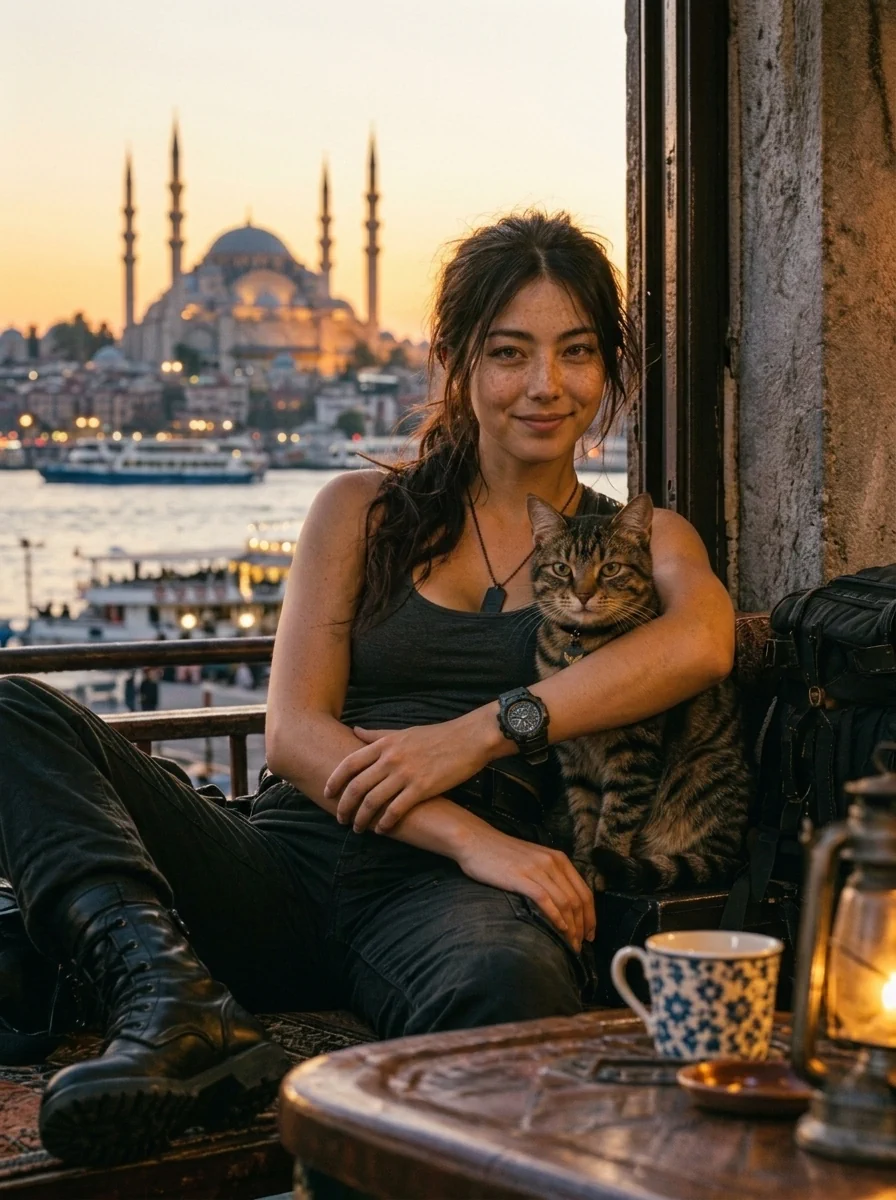
Equipped with specialized monitoring and communications hardware, K'hraal is considerably more involved in Tanya's affairs than an ordinary household pet.
He is also still very much a cat.
His presence introduces a peculiar contradiction into Tanya's carefully controlled professional world.
An operative accustomed to classified equipment, hazardous assignments, and exacting procedures must occasionally contend with a companion who considers an unsecured object an invitation, an unfamiliar animal a pressing social obligation, and an expensive piece of equipment a perfectly acceptable place to sit.
Tanya understands him largely through his gestures, expressions, and behavior.
Whether K'hraal is genuinely anticipating her intentions or simply exploiting her patience is sometimes difficult to determine.
Their relationship reveals a side of Tanya rarely visible in official records: her humor, affection, occasional exasperation, and the unguarded domestic moments that exist between assignments.
In Istanbul, where their adventures frequently intersect with ordinary civilian life, those moments can be as revealing as any mission.
The Living Shadow
Tanya's past has never been entirely accessible—even to Tanya herself.
During her operative years, selective memory compartmentalization formed part of a broader security culture in which an agent's knowledge could become a vulnerability if captured or compromised.
Those controlled absences were fundamentally different from the devastating memory loss that would later change her life.
At some point, the woman who once navigated covert operations with extraordinary confidence becomes disconnected from much of the history that defined her.
The legendary operative gives way to a civilian existence.
A waitress. An ordinary working woman with routines, customers, familiar streets, and a life that no longer appears connected to the dangerous world she once inhabited.
But forgetting an experience does not necessarily erase everything that experience taught the body.
An unfamiliar gesture feels instinctively correct. A sound attracts her attention before anyone else reacts. An ordinary object triggers an inexplicable response. Occasionally, a fragment of recognition emerges without an accompanying memory.
These are not complete recollections.
They are traces.
And somewhere beyond her ordinary life remain the people, institutions, and unresolved consequences of a history she no longer knows how to retrieve.
The Woman Beneath the Armor
Tanya D'Gaul's significance lies not only in the military technology she helped develop or the operatives whose existence can be traced, in part, to her biological and professional legacy.
It lies in the distinction between capability and identity.
Her younger counterparts may possess enhanced strength, faster reactions, superior coordination, and engineered advantages she could never acquire naturally.
Yet those advantages do not diminish what made Tanya exceptional.
Her experience was earned. Her judgment was shaped by consequences. Her restraint came from understanding the true cost of violence.
And the woman who eventually loses access to that history remains, in important ways, the person who lived it.
Her story is therefore not simply about a legendary operative trying to remember her past.
It is about what remains of a person when the past itself becomes inaccessible.
Before the C.A.A.T.s learned to surpass human limitations, Tanya D'Gaul had already demonstrated what an extraordinary human could become.