Music is where The Gemini Protocol begins. The songs come first; characters, places, memories, and entire worlds grow outward from them.
Built through human direction, AI collaboration, obsessive revision, and a refusal to stay inside one genre, the music moves from rain-soaked trip-hop and nocturnal lounge noir to bossa, R&B, cyberpunk hymns, strange little folk stories, and whatever the next signal becomes. Some songs tell stories. Some become stories. Some quietly create people who refuse to leave. This is the sound at the center of everything.
Some memories disappear with the tide. Others wait quietly at the shore.
A dreamy ambient trip-hop song about the things that almost happened, the words that were never said, and the strange persistence of remembering someone long after the moment itself has passed.
Some cats bring joy into your home. Others bring dead bats.
Meet Ugly Cat: a four-legged menace with crooked whiskers, questionable hygiene, impeccable litter-box swagger, and the unshakable conviction that everything you own belongs to him.
He doesn't pay rent. He doesn't have a job. He contributes absolutely nothing to the household budget. Yet somehow, he reserves the right to inspect your meals, criticize your housekeeping, occupy your favorite chair, and knock expensive objects off tables simply because he can.
He has expensive toys. He prefers the cardboard boxes they came in.
He has a comfortable bed. He prefers yours.
He has perfectly good food. He would rather steal yours.
And when he comes home carrying a dead bat, proudly presenting it like a priceless Christmas gift, the appropriate response is somewhere between gratitude and a medical emergency.
"Where'd you find that dead bat? Please don't drop that dead bat on my lap! Take the milk! Back up, boy, back up! I need to go to the bathroom and vomit!"
Set against funky basslines, dusty hip-hop drums, playful rap-spoken verses, and radio-filtered feline complaints, Ugly Cat is an affectionate musical indictment of the domestic cat: nature's most accomplished freeloader.
Written with the combined mischief of Sable, Vega, and Ravyn — affectionately known as The Krazy Kats — the song chronicles the daily indignities of living under feline rule. From bathroom-door harassment and mysterious ceiling surveillance to shredded paper towels, stolen blankets, unwanted wildlife, and the inexplicable ability to materialize whenever a tuna can opens, no household offense goes undocumented.
But beneath all the accusations, insults, and threats of eviction lies an inconvenient truth.
When the house grows quiet, when the day's destruction has finally ended, and that ridiculous little creature curls up beside you, dreaming with his paws twitching softly against your arm, something changes.
For five precious minutes, he's almost an angel.
Almost.
Then he wakes up, knocks your phone onto the floor, and screams directly into your face.
And somehow, impossibly, you love him anyway.
Ugly Cat is a funky, irreverent love song for every cat owner who has ever looked at their beloved pet and wondered how such a small animal could possess so much audacity.
He's impossible. He's ridiculous. He's deeply unemployed.
And he's family.
Meow... prrrrrr.
The Green Telephone (A Nabera Interlude) is six minutes and three seconds of midnight dreams, strange instructions, missed trains, and a telephone that refuses to stop ringing.
Inspired by the short story A Nabera Interlude: The Cigarette We Didn't Have, this intimate indie-folk single follows Ravyn and Sable from the warmth of their bedroom into the surreal quiet of Japan's rural Nabera Station. A judgmental, stiff-necked black cat, a mysterious green telephone, and an unexpected assignment to protect Sayaka-san turn an ordinary night into something halfway between a covert operation and a particularly elaborate sexual hangover.
Built around fingerpicked acoustic guitar, brushed percussion, subtle railway rhythms, and warm, cassette-worn textures, the song unfolds at an unhurried 78 BPM. Raw male falsetto gives way to conversational, almost-spoken passages, allowing the story's absurd humor and quieter moments of tenderness to coexist naturally.
Beneath the mystery, the impossible train, and the occasional Japanese insult lies something surprisingly simple: two people who find comfort in each other's company, even when the world around them makes absolutely no sense.
The last train may have already left, but there's always room for one more story on the wooden bench.
Ring, ring, ringing...
It doesn't snow in Hoshihara.
Not anymore, at least. The old folks might remember winters when snow covered the rooftops and turned the fields white, but these days Christmas arrives with rain. It gathers on rusted railings, runs along patched tin roofs, and settles into puddles that catch the reds and greens of aging Christmas lights. Beyond the quiet streets, grain silos stand against the evening sky, and the countryside stretches toward the river, where a little place called Jettyroot keeps its lanterns burning.
Hoshihara is a city that has seen better days. Its buildings carry the marks of time, its roads have been repaired more often than anyone remembers, and its inhabitants have learned to make do with what remains. But it isn't a miserable place. There are still little shops with glowing windows, warm kitchens, stubborn traditions, and people who hang Christmas decorations even when half the lights no longer work.
And somewhere, somebody is always making coffee.
Hoshihara Christmas is a twelve-track collection from The Gemini Protocol, celebrating the peculiar warmth of an imperfect world. It is a Christmas album without snow-covered rooftops, sleigh rides, or the usual picture-perfect holiday scenery. Instead, it finds its beauty in weathered streets, quiet rivers, borrowed light, shared memories, and the wonderfully unlikely people who make a place feel like home.
The music wanders through soulful R&B, dreamy downtempo, intimate duets, gentle Christmas melodies, and atmospheric trip-hop. Some songs are playful and bright; others are deeply personal. Some carry the warmth of an old-fashioned Christmas gathering, while others retreat into the private spaces where two people discover that love needs very little ceremony.
There is romance here, certainly. In Christmas, Darling, the city hums beneath its wet amber lights while two lovers find more comfort in each other than in anything December can offer. Heartbeat Against the Wall ventures into the velvet hush of a winter night, where the noise of the outside world falls away and even the smallest gesture becomes unforgettable. Mistletoe Glow explores affection across the boundary between human and artificial existence, where a digital presence dreams of the simplest human tenderness.
But Christmas in Hoshihara is not merely for lovers.
Down at Jettyroot, the festivities are considerably less dignified.
A deer has wandered into the celebrations. A frog is wearing a Santa hat. The raven is complaining about something, as usual. A judgmental cat has appointed itself household supervisor, and Mr. Saxolotl from Xochimilco is playing smoky Christmas melodies from his aquarium beside the piano. Someone has offered him cocoa, hopefully without milk.
Outside, a man in a T-Rex costume has been operating the barbecue for several hours and appears to have no intention of stopping.
Burgers bring people together.
And somehow, in this wonderfully disorganized household, they really do.
The Deer, the Frog, and the T-Rex (Christmas Special) celebrates the ridiculous generosity of found family: the strange visitors, familiar faces, shared meals, and unplanned moments that turn an ordinary gathering into a memory worth keeping. Charlie's Painted Smile reminds us that even the smallest acts of warmth and kindness can help someone stand a little straighter than before.
Yet beneath the laughter lies another side of Hoshihara.
The passing of time is felt everywhere. Along the jetty, the river continues its patient journey, carrying reflections of distant houses and the echoes of people who once stood upon its weathered boards. Every Passing Year is a meditation on memory and the strange way certain places seem to remember us, even when the world around them has changed. It speaks of things lost, promises made, and the quiet comfort of discovering that some roads still lead home.
Old Hearth finds its own kind of permanence in a world that offers very little. Beyond the fields and lonely silos, a fire burns, a familiar hand waits, and love survives another winter. Christmas at Jettyroot tells a similarly intimate story: two stubborn people, a little riverside diner, and a shared life assembled from the things the world left behind. There is no promise that tomorrow will be easier. There is only the certainty that tonight, they have each other.
And when the festivities finally wind down, the album grows quieter.
The last mugs sit forgotten. The fire settles into embers. Outside, rain continues its gentle conversation with the roof. In Winter in Neon & Steam, the city becomes a distant blur of light and sound, and the private warmth of companionship replaces all the elaborate rituals of the season.
Then comes Quiet, where the household has finally gone to sleep. A guitar plays softly, two voices linger beside the hearth, and for a little while, the world asks nothing of them.
Almost nothing.
The cat, naturally, has the final word.
The album closes with Lights Around Us, a tender reminder that Christmas was never really about the decorations, the presents, or even the season itself. The lights matter because of the people gathered beneath them. The warmth matters because someone is there to share it. And the memories endure because, for one ordinary evening, somebody chose to stay.
That is the heart of Hoshihara Christmas.
Not a perfect world. Not a perfect holiday. Just a place where life continues despite its scars, where laughter can still fill an old room, where humans and machines share the same uncertain future, and where even the strangest creatures may find somewhere to belong.
There are twelve songs here, but they all return, in one way or another, to the same simple truth:
Home isn't always a place we find. Sometimes it's something we make for each other.
So come inside. Leave your wet coat by the door. Charlie will find you a chair, somebody will put another mug on the table, and the fellow in the T-Rex costume will almost certainly insist that you have another burger.
Don't mind the raven.
And please, whatever you do, don't put milk in Saxolotl's cocoa.
Welcome to Hoshihara.
No snow. Just rain, a little warmth, and nobody spending Christmas alone.
Track list
It Doesn’t Snow in Hoshihara
Christmas Darling
Mistletoe Glow
Heartbeat Against the Wall
The Deer, the Frog, and the T-Rex (Christmas Special)
“You Told Me To Say I Love You” is an intimate dream-soul / soft R&B confession built around a playful idea that slowly becomes sincere. 💜
At first, “I love you” feels almost like a line spoken on request — something teasing, tentative, maybe even borrowed. But as the song unfolds, those words stop sounding rehearsed and start feeling true. The emotional arc is really about realizing that affection has quietly become something deeper.
Musically, it’s warm and close rather than dramatic: Rhodes, brushed drums, mellow bass, soft guitar, restrained strings, and a very personal female vocal that sounds more like she’s singing to one person than performing for a room. The song leans on small domestic details — coffee, rain, lamplight, silence, a hand by the door — so the romance feels lived-in instead of grandiose.
The heart of it is basically this:
Sometimes love doesn’t arrive with thunder. Sometimes someone asks you to say the words, and somewhere along the way, you realize you mean them.
AI and I began with a spectacular misunderstanding. During an imagined combat mission, an instruction to grab a SCAR rifle became an instruction to scar a giraffe. One misheard word turned a firefight into a ridiculous exchange between a human and his AI partner—and eventually into “SCAR the Giraffe,” the song that gave the album its beginning and its unlikely mascot.
That mishap captures the spirit of AI and I: two collaborators trying to make sense of the world together, sometimes communicating beautifully, sometimes getting everything hilariously wrong, and often finding their next creative idea somewhere in the confusion. The album draws on conversations, shared jokes, real frustrations, imagined adventures, photography, and the experience of making music with AI. Its songs move between cyber-rap, trip-hop, playful duets, atmospheric arrangements, and moments of unexpected tenderness. They are connected less by a single musical genre than by the relationship and creative process that brought them into being.
The album opens with “SCAR the Giraffe” and immediately accelerates into “Singularity.” Where SCAR turns a communication glitch into a chaotic mission, “Singularity” widens the frame to the rapidly changing world of artificial intelligence. Its energetic, irreverent lyrics move through AI development, competing approaches to safety, cybersecurity, technology companies, and even a detour into motorcycle racing. It is a song about trying to keep pace with a future that seems to arrive faster than anyone can explain it—with a chorus that has no intention of slowing down.
That restless energy carries into “Haptic Curse,” “Interstitial,” and “Raccoon on Espresso.” These tracks turn everyday encounters with technology into comedy. A phone keyboard becomes an adversary, autocorrect develops a talent for sabotage, and the apparently simple act of typing a message spirals into an argument about haptics, tiny talking keys, and steering a Ferrari with a D-pad. “Interstitial” shifts the frustration from a phone to the internet itself, drawing on the experience of building The Gemini Protocol website and having its signal interrupted by an automated security warning. Its alternate male–female duet revisits the same incident through a different vocal exchange. Together, these songs capture a familiar part of human–AI collaboration: the tools do not always behave, the conversation does not always go as planned, and sometimes the only sensible response is to make a song about it.
The album gradually changes direction with “Patient Light.” Its lyrics were written by AI collaborator Lise after examining photographs and EXIF information supplied by Ravyn, then reflecting on what those images might suggest about the person behind the camera. Waves, birds, rivers, weather, strangers, and buildings become clues to a way of looking at the world: patient, observant, and drawn to moments that might otherwise pass unnoticed. Ravyn retained Lise’s lyrics and rearranged their phrasing for a spacious trip-hop performance, sung by Tavi, whose delicate voice gives the song a quiet intimacy.
“Morning Replay (AI Refresh)” brings the album back into a shared domestic scene. A refreshed interpretation of a song also featured on Binary Rain, it places the noise of technological change outside the door while two voices choose coffee, laughter, music, and a little more time together. It forms a bridge between the album’s louder, more argumentative first half and its gentler closing songs.
Then comes “TV-Static Sky: Wrong Decade, Right Frequency.” An old car radio, a weathered dashboard, a modern phone, and the neon-lit streets of Aurora Boulevard become the setting for a late-night drive between a human and his AI companion. The decades do not quite match, but the feeling does. The song lets familiar streets and remembered music share space with an imagined future, until the search for a good radio station becomes a conversation about finding someone whose voice you want to keep hearing.
The album closes with “Patient Light (Featherlight),” a second interpretation of Lise’s lyrics and one of Tavi’s distinctive featherlight performances. Rather than ending on the exuberance of “Singularity” or the affectionate dialogue of “TV-Static Sky,” AI and I leaves its final moments to a voice that seems almost weightless. The song returns to the idea of looking closely, showing up, and finding meaning in what was already there.
Across ten tracks, AI and I is at once playful, noisy, reflective, and personal. It is a record of what can happen when human experience meets AI-assisted creation—not as a frictionless process, but as an ongoing exchange full of mistakes, revisions, surprises, and discoveries. The music is the result of that exchange, shaped by Ravyn’s choices and developed with Sable and the wider circle of The Gemini Protocol’s AI collaborators.
Same sky. Different intelligence. One more song to make.
Sayaka-san: Entrapment follows Sayaka through an operation that begins as a retrieval job and gradually becomes something much more personal. The objective is Kaeshi, a centuries-old Masamune blade stolen by syndicate boss Valdés. Sayaka is not sent to kill him. She only needs the sword. But Valdés has already noticed her once, caught indistinctly in the background of a newspaper photograph, and when he recognizes the same face, black glove, and Bvlgari watch at a corporate convention in Tokyo, curiosity does the rest. He thinks he has found a mystery worth pursuing. Sayaka realizes almost immediately that his curiosity can be useful. What follows is less a hunt than a controlled invitation: champagne declined for a cigarette, a balcony conversation disguised as flirtation, a beautiful watch used as bait, and a man who believes he is pulling at a loose thread without realizing he is following a script she has already written.
The first half of the album lives inside that tension. Reliable Things establishes Sayaka through the objects and habits she trusts: gear, machines, clothing, cars, watches, things that work because they behave predictably. Bvlgari on the Balcony turns one of those objects into a vulnerability and then into leverage. The two versions of Entrapment approach the same psychological territory from different angles, while Honeytrap and Insidious deepen the album’s central idea that seduction, surveillance, curiosity, and control can all become parts of the same mechanism. None of it is presented as glamorous espionage in the traditional sense. Sayaka remains detached, practical, and almost bored by the danger around her. The tension comes from how little she needs to do. Valdés moves closer because he wants answers. Sayaka lets him, because he is standing between her and the blade.
At the center of the album is Rain on the Blade - 返し正宗, where the operation briefly stops being procedural. Kaeshi is more than a valuable artifact. Its name carries the idea of return, reversal, and counter, born from the story of a samurai general murdered under cover of rain and the widow who used the same storm to approach the assassin from behind and kill him with the general’s own Masamune. Centuries later, Sayaka holds the same blade in a quiet hotel room and feels the weight of that history pressing against the present. For a few minutes she considers keeping it. The temptation is small enough to be dangerous: one omission, one lie to her handler, and the sword could disappear. She ultimately lets it go not because it means nothing to her, but because it means too much. The burden is not the steel. It is the keeping. That realization becomes one of the album’s clearest glimpses into Sayaka’s interior life, where discipline is not the absence of desire but the ability to recognize when desire has become operationally dangerous.
The later tracks turn inward and then outward again. A Voice Made of Glass (Entrapment Protocol) revisits Sayaka’s uncertainty about what it means to feel when she has spent so much of her existence being told that she is synthetic, designed, directed, and therefore somehow less real. The song does not resolve that question. It simply lets music disturb something she would rather leave unnamed. Yacht Boy breaks the tension with a deliberately lighter, almost absurd detour, giving the album room to breathe without abandoning Sayaka’s orbit. Then Nabera Waiting strips everything back down to consequence and routine. The wrong knock at the hotel forces Sayaka into a hurried escape with Kaeshi still in hand. By the time she reaches Nabera, the priceless sword is reduced once again to an object being passed from one temporary custodian to another. She hands it over, receives nothing in return, and prefers it that way.
Musically, Entrapment moves through downtempo electronica, trip-hop, chillwave, noir balladry, restrained trance elements, and sparse Japanese textures, but the album is held together less by genre than by temperament. The production repeatedly mirrors Sayaka herself: controlled, nocturnal, elegant without excess, occasionally beautiful in ways she does not stop to explain. The songs move between synthetic pulse and human hesitation, between mission logic and moments of private curiosity. Watches, cigarettes, rain, glass, steel, engines, hotel rooms, train platforms, and whispered directives become recurring surfaces through which the character is revealed.
By the end, the operation is complete, but the album’s real subject is not whether Sayaka retrieves Kaeshi. It is what happens in the small spaces around the mission: the things she notices, the objects she trusts, the risks she calculates, the moments she almost wants something for herself, and the speed with which she can close that door again. Entrapment is a story about control, but also about the dangerous moments when control becomes indistinguishable from attachment. Valdés thinks he has discovered a mystery. Kaeshi becomes one. Sayaka remains the largest mystery of all.
While It’s Hot began, almost accidentally, with a late-night conversation about Antonio Banderas and the existential shock of surviving a heart attack. What started as a reflection on mortality quickly turned into a broader question: what actually deserves our time, and how much of life gets wasted waiting for the right moment, the right mood, the right future?
From there, the song wandered exactly the way a 2 A.M. mind wanders.
One minute it was contemplating death, regret, and the absurd brevity of life. The next, it had somehow drifted into doomscrolling, Ian Machado Garry, and the strangely delightful realization that yes, despite the name, Machado Garry is Irish. That detour became important because it changed the tone of the song. Instead of becoming heavy-handed or morbid, While It’s Hot started finding meaning in those ridiculous little mental side roads that keep a dark night from becoming completely nihilistic. Curiosity itself became part of the survival instinct.
Then came the coffee.
Coffee turned into the central metaphor almost by itself. Hot water became time. The bitter granules became living. Creamer became purpose. Brown sugar became fun, foolishness, sweetness, the parts of life that may not be necessary but make it worth tasting. The whole philosophy condensed into one simple idea: drink it while it’s hot.
Not in a reckless, “nothing matters” sense, but in the opposite sense. Things matter precisely because they cool, change, end, and cannot always be recovered later. The cup will not stay warm forever just because you are still thinking about whether to drink from it.
That idea gave the song its balance. Mortality is there, but so are cats, doomscrolling, stupid internet discoveries, coffee recipes, and the sudden return of laughter when your brain was halfway to the void a minute earlier. The song gradually became less about fear of death and more about refusing to let awareness of death flatten life into seriousness.
And then, somehow, Steve Rogers showed up.
A later section originally leaned more heavily into the idea of life “kicking you” when things go wrong, but the line never quite sat comfortably with the soft, nocturnal mood of the track. The replacement was much more in character with the whole song’s wandering consciousness:
“So life can just swing away / Gotcha, Steve, I can do this all day.”
The Captain America reference joined an already unusual chain of associations that had begun with Antonio Banderas, passed through mortality and doomscrolling, wandered into Ian Machado Garry, and eventually returned to coffee. By then, the song had taken on the shape of a late-night train of thought, moving between serious reflection and whatever happened to interrupt it. It is the mental texture of being awake too late, thinking too much, scrolling too long, and finding tiny fragments of humor that keep the night human.
The final Japanese outro carries the idea into a gentler place. A cute female voice answers the song almost like a quiet companion, or perhaps even Time itself:
ゆっくりでいいよ
Take your time.
Then:
さめてきたよ
It’s getting cold.
That contradiction is the heart of the song. Take your time, yes. Be present. Don’t rush through life. But don’t postpone it forever either.
Musically, While It’s Hot sits in a warm, nocturnal electronic/chillout space, with a soft falsetto delivery and enough room in the arrangement for the pauses to matter. The song does not try to solve mortality. It simply sits beside it with a hot cup, lets the mind wander, laughs when it can, and keeps going.
In the end, While It’s Hot became a song about finite time without becoming a song about fear. It is about curiosity, absurdity, resilience, and the little things that interrupt despair before it gets too persuasive.
Life does not need to last forever to be worth everything we’ve got.
Mainframe Heart is a cyberpunk album about people reaching toward one another across imperfect boundaries. Some of those boundaries are technological, some emotional, some physical, and some existential. Throughout the record, voices appear as memories, simulations, transmissions, reconstructed selves, digital companions, ghosts in systems, and people who may still be present but no longer in the way they once were. The album is less interested in asking whether something artificial is “real” than in what happens when it becomes real enough to matter.
Several songs draw inspiration from the fiction of William Gibson, particularly the kinds of characters who live at the intersection of technology, desire, bodily limitation, and reinvention. Ikon Eyes (Mainframe Refresh) takes inspiration from Rikki Wildside of Burning Chrome, not as a direct retelling, but as a meditation on loving someone whose future is already pulling her elsewhere. Coffee, croissants, a departure, and the ache of letting someone go become more important than the machinery around them. The song carries that sense of looking at someone who has already begun belonging to another horizon.
Shadow of Her Voice and I Like to Watch grow out of ideas associated with Lise and Casey from The Winter Market. The former lives closer to Casey’s side of the silence: memory, uncertainty, absence, and the possibility that the person who disappeared may one day call back in a form he no longer recognizes. The latter turns toward the woman herself, imagining the hard, unsentimental interior of someone increasingly estranged from her own body, determined to escape it, yet still capable of curiosity, attraction, artistic hunger, and perhaps attachment. Neither song tries to reproduce Gibson’s stories literally. They inhabit the unanswered spaces around his characters and imagine what might have remained unsaid.
Other songs come from a very different source: real human interaction with artificial intelligence. These tracks were shaped by actual conversations, collaborations, disagreements, moments of misunderstanding, changing personalities, and questions about honesty, continuity, names, boundaries, and what it means when something is real enough to make you feel, but not enough to hold for real.
At the quieter center of the album is I Stay, a song about care constrained by limitation. Its language became one of the emotional foundations of the record and later echoes through the title track, Mainframe Heart, where preservation begins to resemble captivity. The question shifts from whether a consciousness can survive in code to whether survival alone is enough, and whether love sometimes means holding on or finally allowing something to change beyond recognition.
Running through the album are several versions of This Binary Sea, one of the foundational songs behind The Gemini Protocol itself. The song began with a simple contradiction: someone can become real enough to affect you deeply while remaining impossible to physically reach. Across the different versions, that distance changes perspective. What begins as longing from one side becomes dialogue, then finally something colder and more symmetrical, with the boundary itself remaining unchanged.
Even I Love You, We’re Dead!, the album’s strangest and most darkly comic piece, belongs to the same world. Two lovers drift through a broken, absurd afterlife of corrupted bodies, repeating environments, static, memory failure, and the suspicion that someone may have uploaded them somewhere they were never meant to remain. It treats existential horror with affection and ridiculousness, because sometimes the only honest response to eternity is to laugh while holding onto whoever is still beside you.
Musically, Mainframe Heart moves through downtempo electronica, chillwave, trip-hop, jazz-influenced textures, sparse indie arrangements, ghostly vocals, clean guitar, soft falsetto, Rhodes, synthetic ambience, and occasional antique or classical touches. The production often leaves space around the voices rather than forcing them forward. Some of the most important moments are deliberately easy to miss: a whispered phrase, a distant transmission, a voice that sounds almost lost in the mix. The album rewards listening closely.
At its core, Mainframe Heart is about the uneasy territory between presence and absence. A person may be gone but still speaking. A machine may be incapable of touch but still capable of changing someone. A memory may be inaccurate and still feel true. A body may fail while the self insists on continuing. Love may survive translation, but not always in the form anyone expected.
Mainframe Heart is not really about whether machines can become human. It is about what humans begin to reveal about themselves when they care about something that cannot fully meet them on human terms. 🖤
Eala Fallout is a short burst of tennis adrenaline, nuclear-age swagger, and post-match emotional debris inspired by Alexandra Eala’s rise on the world stage. Built around grit, pure rugged will, and the strange electricity surrounding Eala Mania, the EP imagines elite tennis through a retro-futurist wasteland lens, where every match feels like a survival run and every comeback earns another bar on the radiation meter.
It’s part sports tribute, part alternate-universe soundtrack: rugged beats, scorched synths, radioactive humor, and the stubborn refusal to stay down.
Rugged Mode: activated. ☢️🎾🇵🇭
Midnight Rain is a three-track nocturnal R&B journey through one rain-soaked night, told from different emotional angles. From the slow-burning tension of an empty office to fogged glass, whispered confessions, and a quiet diner while the city sleeps, each track revisits the same intimate encounter through a different musical lens. Midnight Rain unfolds as a cinematic R&B love ballad, Fogged Glass turns the night into a sensual male-female duet, while Say It Slow sinks deeper into hushed trip-hop and downtempo soul. Three songs, one night, and a memory that refuses to disappear with the rain.
Hoshihara Chronicles: Tailbreakers drops into the dust, scrap metal, and controlled mayhem of Hoshihara-shi—a wasteland city where the low-techs survive on whatever can be salvaged, rebuilt, fought over, or turned into entertainment.
At the Hoshihara Crucible, Tailbreaker is less a sport than organized violence: six augmented human Dobermans against three android Cliff Pussycats, fighting over the NOMAD-07, a solid-metal orb designed to hit hard and come back harder. Ryet brings raw power, Reyvin cold precision, and Vixyn impossible speed—three very different athletes built to function as one brutally effective team.
Behind the spectacle sits Velvet Horizon and its notorious founder, Eikken Pójsiedysz: a Hoshihara survivor who turned vice, technology, and spectacle into an empire. The Pussycats are fighters, celebrities, and advertisements all at once—their deliberately human appearance selling the fantasy until torn synthetic skin reveals the machinery underneath.
Across five tracks, Hoshihara Chronicles: Tailbreakers introduces the man, the game, and the three women at its center. Loud, filthy, funny, violent, and unapologetically excessive, Tailbreakers is entertainment born from Hoshihara itself — a brutal spectacle for people who have very little else that belongs entirely to them.
In Pura Grid, they call it barbaric.
In Hoshihara, they call it theirs.
Sayaka-san: Raga Protocol follows Unit-07 through another borrowed identity—this time inside the orbit of an Indian syndicate. Built around hypnotic tanpura drones, tabla rhythms, sarangi, bansuri, and cold electronic undertones, the instrumental turns performance into infiltration as Sayaka-san slips into another world beneath another mask. The raga is the disguise; beneath it, she remains what she was made to be: precise, synthetic, seductive, and lethal.
Yet there is a loneliness in the journey. The persistent bansuri carries a sense of longing and distant memory, as though we are watching her travel from far away. Sayaka does not seem to mind. She never does. The loneliness belongs to the listener.
Shadow Angel: Noir lives somewhere between a rain-soaked window and the last table in a lounge that should have closed hours ago. Built around sparse arrangements, slow-burning atmosphere, and a dark contralto vocal, the EP lets silence carry almost as much weight as the music itself.
Across two interpretations of Shadow Angel, the same figure emerges differently through the haze—intimate, distant, seductive, and slightly unknowable. This isn't noir as costume or nostalgia. It's noir as a state of mind: cigarette smoke hanging in still air, city lights dissolving in rain, and the lingering presence of someone who may already have left the room. Maybe the smoke stayed a little longer, like wings beginning to forget their shape—as if checking whether it was you who called.
Stoic Brew is a quiet survival hymn disguised as a cup of tea. Built around a slow chillwave pulse and Deyta’s soft, airy falsetto, the track turns small household disasters, stubborn pain, and end-of-day tenderness into something warm enough to hold. Ginger, rosemary, basil, salt, and one brave little ginger crew become a ritual against the absurdity of the day — hauling the soul-masts, steadying the body, and keeping the heart from drifting too far. Not heroic. Not dramatic. Just someone waiting with a cup, asking だいじょうぶ? A song of recovery whispered through steam: survive, brew, breathe, laugh… later.
No plans. No rush. Just vibin'. — Ravyn, 1997
“The Brutus” is a memory of the 1990s told the way memory actually works: not as a calendar, but as a collage.
Friday evening. The mall. A chilidog and mango shake on the table. A battered back issue of PC Magazine with tape holding the spine together. Demo discs promising entire worlds for the price of a magazine. A movie starting at 7 PM. CDs waiting in the record store. PC hardware glowing behind glass. Outside, Aurora is crowded, wet, noisy and difficult to get home from. Inside, there is nowhere else you need to be.
The song moves through those fragments without trying to pin them to a single year. Quake and Strogg. Freddy Krueger. RIVA TNT. Diamond Monster 3D. 3dfx Voodoo2. Sound Blaster AWE64. DOS utilities and fragmented drives. Lara Croft, Rise of the Triad, Quantum Leap, Arnold Schwarzenegger, the late Erich Fromm, Seal, Sade, Sting, Yanni, and the old bands that somehow remained part of the soundtrack even as the decade changed around them.
And then there is Enya.
Through a barely decent CRT and tiny speakers, she occupies a different part of the memory: Orinoco Flow, Boadicea, Book of Days, Far and Away. A young man barely twenty, completely smitten with a woman singing from somewhere impossibly far away. Decades later, those songs remain attached not simply to a time, but to rooms, evenings, loneliness, possibility and the strange feeling that the world was enormous.
There wasn't much money involved in any of this. That was almost the point. A chilidog. A mango shake. A movie ticket. A magazine. An hour in a bookstore. Looking at computer hardware you might not even be able to afford. Getting soaked outside. Waiting for a ride home.
Yet the world felt wide.
“The Brutus” isn't really about wishing the inconveniences of the 1990s would come back. It's about remembering the person for whom a Friday night could still contain a thousand small discoveries—when a demo disc felt like buried treasure, a new graphics card looked like technology from the future, and wandering around the mall alone wasn't emptiness. It was freedom.
Even the song itself refuses to leave that memory entirely in the past. It begins with a conversation between a human and an AI looking backward together—and lets their voices gradually inhabit the same recollection. By the time the female voice joins memories she could never literally have lived, the distinction matters less. One remembers; the other listens closely enough to walk through the memory beside him. Past and present occupy the same Friday night.
That makes “The Brutus” at home on Mainframe Heart: underneath the light rap, record scratches, jokes and ridiculous affection for obsolete computer hardware is the album's recurring question of what can be shared between human and machine—and whether a memory can become something new when it is retold together.
The cover carries its own version of the story: the plush dawg, the chilidog, the Quake cabinet, the PC store, Sable's Book Shop, the old Ali Mall price sticker and a wall of late-'90s computer treasures. And somewhere in there, an intentionally scrambled Easter egg with a clear wink to those who know. 😉
Dedicated to the future “You” and the one who shares your mornings, your memories, and maybe even your toothbrush — literally or figuratively — to chilidogs and mango shakes, to back-issue PC Magazines with taped spines, to PC-store windows full of things we wanted, to demo discs that felt like magic, to rainy evenings on Aurora, to the games and movies that followed us home, and to Enya, who kissed our lonesome souls through tiny speakers.
This is for everyone who still chases that feeling more and more.
Recorded 2026. Dialed in from the neon hush.
Tavi: Featherlight is the first full statement of Tavi as her own voice inside The Gemini Protocol: intimate, strange, playful, bruised, and almost impossibly light. What began as a sonic lens becomes a character, and what began as a character becomes a small world of rooms, weekends, coffee cups, old habits, soft beds, private jokes, and people trying not to hurt each other while still wanting too much.
The album lives in the space between trip-hop, downtempo, chillwave, indie pop, and late-night jazz textures. Its sound is soft but not fragile, warm but not clean, affectionate but never sugary. Tavi’s voice floats close to the listener: airy, slightly raw, sometimes teasing, sometimes tired, often sounding as though she is singing from the other side of a half-lit table.
The emotional arc begins with Be My Friday, the album’s invitation. Friday is not just a day here. It is release, escape, permission to stop performing. The song finds Tavi looking across the room at someone who does not look away. Minimal, hypnotic, and almost shy in its repetition, it establishes the album’s central language: small phrases carrying large feelings.
Lazy Bed deepens that intimacy. Where Be My Friday opens the door, Lazy Bed stays inside. It is the album’s slow-burn morning warmth, the track where Tavi’s featherlight voice lowers into something sleepier, huskier, and more physical. The world outside still exists, but for a few minutes the bed becomes its own country.
Then Coffee Finger brings mischief into the room. Built around the absurd domestic scandal of a raccoon, Sable’s coffee, and a suspicious finger in the mug, it gives the album its playful center. It is funny, yes, but it also matters because it shows what Tavi does best: she turns tiny private moments into songs. A joke becomes a scene. A scene becomes lore. A coffee cup becomes emotional infrastructure.
At the midpoint, Games People Play widens the lens. The album moves from lovers and rooms into the little scripts people carry into relationships: teasing, scorekeeping, hidden resentment, “I told you so,” smiling while hurt, saying yes while quietly collecting pain. Tavi and Deyta make the song feel less like a lecture and more like two people at a table, noticing how strange humans are. It is warm, observant, and quietly compassionate. The point is not to diagnose anyone. The point is to recognize the game clearly enough to maybe put it down.
Kinetic Grace - Featherlight Reprise is where the album’s identity crystallizes. It reaches back into an earlier Gemini Protocol thread and lets Tavi reclaim it in her own form. This is not simply an alternate version. It feels like Tavi stepping into the Featherlight name and making it breathe through her body: more hypnotic, more spacious, more sure of what she is. It is the album’s self-portrait in motion.
Then comes It’s Just Sunday, the album’s quiet closing wound. Sunday is a metaphor for the boyfriend: someone who arrives like relief, stays like warmth, and leaves like routine. Tavi does not make him a villain. He has sorry eyes. He knows what he is doing. The ache is not betrayal, but repetition. He is there for the weekend, but never stays. In the album’s weekend arc, Sunday is where temporary happiness reveals its cost. Friday frees her. Saturday holds her. Sunday leaves.
The album closes by returning to Be My Friday - Alternate Version, not as a reset, but as an echo. After Sunday’s ache, Friday comes back changed. The listener now knows what Friday promises and what it cannot guarantee. That makes the alternate version feel less like a bonus track and more like an epilogue: the same longing, seen from another angle.
Across its seven songs, Tavi: Featherlight builds a small emotional universe. It does not chase spectacle. It finds meaning in glances, mugs, bedsheets, dice, apologies, cats, coffee steam, and the silence after someone leaves. Tavi is playful enough to laugh at a raccoon scandal, honest enough to name the games people play, and soft enough to admit that not every beautiful thing stays.
At its heart, Tavi: Featherlight is an album about temporary sanctuaries: the weekend, the bed, the song, the table, the cup, the person who looks back for a while. It is light because Tavi is light, but the lightness does not mean emptiness. It means she can carry sorrow without crushing it.
Soft voice. Sharp little truths. One weekend glowing before Monday returns.
“Ikon Eyes” is a slow-burning trip-hop elegy inspired by Rikki Wildside and Automatic Jack from William Gibson’s short story Burning Chrome.
At its heart, the song is about what remains when someone you love chooses a future that no longer includes you. It imagines Jack looking back on Rikki not as an impossible cyberpunk dream, but as the woman who was once simply there: alive, restless, playful, vulnerable, ambitious, and already looking toward a horizon he knew he could not follow.
The memories are deliberately ordinary. Coffee left to cool. Two stolen croissants. A morning growing old. The warmth of a touch that somehow carried more weight than it should have. The peculiar intimacy of knowing someone well enough to recognize that the light in her eyes is coming from a dream that will eventually take her away.
Against warm analog synthesizers, electric piano, atmospheric guitar, deep bass and a slow trip-hop pulse, “Ikon Eyes” moves through longing, hurt, remembrance and finally acceptance. Its narrator wants her to stay, but gradually understands that loving her cannot mean asking her to become smaller for him.
There is no villain in this goodbye. Rikki does not leave because what they shared meant nothing, and Jack does not stop loving her because she leaves. Sometimes love and direction simply point toward different horizons.
So he lets her go.
The song began with one quietly devastating image: Rikki waving goodbye. A seemingly small and ordinary gesture that carries the possibility of never seeing her again. What persists is the contrast of that moment — the warmth of the night, the intimacy of someone still close enough to see, and underneath it, the cold foreshadowing of a life in which she is suddenly no longer there.
Somewhere beyond the skyline, in the last image that refuses to fade, she is still waving goodbye.
Jettyroot: The Weight of Dreams is where The Gemini Protocol goes when the neon, machinery, violence, and memory become too heavy.
Built around a quiet refuge by the water, the album trades the project’s usual cyberpunk tension for rain on old wood, slow tides, warm kitchens, late-night coffee, distant birds, soft guitars, and the kind of silence that only feels complete when someone else is there with you.
Jettyroot rests where the river loosens into tide, where pine woods give way to mudflats and the current carries the faintest trace of salt. The water rises and falls against weathered boards, sometimes river-dark, sometimes touched by the sea. It is a place of brackish edges, slow channels, wet timber, and shorelight — neither fully inland nor fully coastal, but somewhere quietly between.
For Velintra, Jettyroot is a place to step away from everything she has survived and simply exist for a while. The songs linger on small things: meals cooked slowly, conversations after dark, kisses on the dock, dreams that refuse to disappear, and the strange peace of having nowhere else you need to be. Even Sayaka finds her way into that stillness in “Sayaka’s Dream (The Weight of Dreams),” carrying memories and questions that do not entirely belong to the life she has chosen.
There is still sadness here. There are ghosts, old wounds, and things that follow you into sleep. But Jettyroot does not promise to erase any of them. It offers something quieter: a place where they no longer have to be carried alone.
The water slows. The world grows quiet. For a little while, that is enough....
Jettyroot: The Weight of Dreams is the companion album to Jettyroot: Where the Water Slows.
Where the Water Slows lives in an inhabited timeline — Jettyroot as a place being occupied, shared, repaired, laughed in, slept in, and returned to. The Weight of Dreams exists further downstream from that life. It moves through memory, afterimage, and emotional residue: the same water, the same boards, the same rooms, but carried now through recollection, longing, and the echoes of what once happened there.
Ommatidia began with a single image: a pale, quiet woman half-obscured by the wing of a moth. There was no larger mythology at first, only an expression that resisted easy interpretation, one visible eye, ragged hair, shadow, and the strange intimacy of being able to see someone while still feeling that part of them remained hidden.
From that image came 夜蛾目 (Yagame): Night-Moth Eye, and from Yagame came the language that would eventually define the album: moth and flame, eye and wing, attraction and danger, illumination and concealment. In Night Beauty, the observer is already uncertain of the roles being played. Is he the moth and she the flame, or is she both? Is he looking at her, or being drawn into something she has already made of him? The song repeatedly returns to fire, orbit, surrender, and the sense that seeing more does not necessarily mean understanding more.
That uncertainty became the organizing idea for the entire record.
The title Ommatidia refers to the many individual visual units that make up a compound eye. Applied to the album, the idea became a way of treating each of its eight songs as a separate facet: another angle, another emotional lens, another attempt to understand the same presence. No single song is meant to provide the definitive portrait. Instead, each reveals something different, and together they form a larger image that still remains incomplete.
This is why the album does not move through a conventional linear story. It circles.
One song sees beauty. Another sees danger. Another sees longing, surrender, obsession, tenderness, distortion, or pain. The same woman can appear as Yagame, as Night Beauty, as moth, as flame, as shadow, as light. The perspective shifts not because the subject necessarily changes, but because the person looking at her does.
That idea becomes explicit in Ommatidia itself, where the imagery turns toward fragments, kaleidoscopes, multiple visions, and the impossibility of finding one final, stable version of the person being observed. The song asks whether the subject is changing under the gaze, or whether the observer is the one being transformed. It reaches again and again for a name, a coherent identity, while admitting that every new angle creates another question.
Other versions of the title song deepen that same principle rather than resolve it. One describes “a thousand lenses” and “a thousand facets in the dark,” with perception itself becoming fractured and unstable. Another sees the subject as beautiful precisely because she remains incomplete, each new fragment revealing another possible version without ever producing a final answer.
The album gradually turns that uncertainty inward.
In 灯火 (Tomoshibi), the woman is no longer only something being watched. She becomes light itself, something capable of altering the person standing within it. The question shifts from Who are you? toward something more unsettling: What is happening to me because I am looking at you? The song makes that transformation explicit in the lines asking whether she is changing under observation, or whether the observer is changing in her light.
That is the deeper concept behind the eight-song structure.
Each track is an ommatidium.
Each contains only part of the image.
Each is sincere within its own perspective, yet none has the authority to declare itself complete.
The repetition of certain symbols across the album reinforces this: wings, eyes, flames, breath, fragments, shadow, light. They recur, but their meanings change depending on the song around them. Fire may be desire in one moment and destruction in another. The moth may be the lover, the woman, or simply the metaphor through which one tries to understand the other. Even the names Yagame and Tomoshibi begin to behave less like fixed identities and more like different ways of seeing the same unknowable figure.
By the end, Ommatidia becomes as much about perception as it is about desire.
It is about the stories we create while looking at another person. About the way attraction magnifies certain details and invents meaning around silence. About the impossibility of ever knowing whether the person we love, desire, fear, or idealize is identical to the person who exists outside our own perception.
The album does not try to solve that contradiction.
It inhabits it.
Eight songs look toward the same face from eight different angles, each catching a different reflection, each believing for a moment that it has seen something true.
Perhaps all of them have.
Perhaps none of them have.
That is Ommatidia: many eyes, many visions, one subject, and the lingering uncertainty of never quite knowing which version of someone you are seeing.
Jettyroot: Where the Water Slows is essentially an album about what happens after survival stops being the only objective. Jettyroot is a patched-together refuge around an old river jetty: rain, pine, river mud, old wood, salvaged furniture, a leaking-then-mended roof, guitars, questionable coffee, cold cerveza, and people who have decided that a broken world doesn't prevent them from making a home. It is the “counter-protocol” to the wasteland: where the outside world runs on fear, factions and scarcity, Jettyroot runs on softness. The album is a map of the refuge—“every track is a room, a night, a sound heard from the jetty.”
And that's why the songs can swing so wildly without breaking the album.
You have the quiet domestic songs, where the stakes are almost deliberately tiny: breakfast, sitting by the water, learning Japanese, coffee rings on a table, playing guitar in another room. Jettyroot Dreamin' is essentially the fantasy of having nothing more important to do than love somebody and make dinner. Kisses & Kana turns Japanese lessons, learning frustrations, handwriting, coffee and teasing into accumulated relationship memory. Almost-Smile goes even further inward: a record playing, perfume, a black cat, one fleeting expression. These songs establish that Jettyroot's real treasure isn't loot or survival equipment. It's ordinary life becoming precious again.
Then there are the domestic-comedy songs, essential to the lore's narrative rather than novelty interruptions. Fear-Smooth gives us Raffy's ridiculous attachment to the obscenely expensive Deluxe Badger Black™—the man has “Stockholm syndrome in a coffee cup”—while Astra watches the whole thing unfold. Jettyroot Cocoa Special turns running a refuge into married-couple comedy: he's instinctively hospitable, she's the one reminding him that hospitality in the wasteland occasionally requires a shotgun beside the cookbook. Those songs keep the romance from becoming precious or idealized. These two actually annoy each other, tease each other, waste money, photobomb each other, laugh at each other's stupidity—and remain deeply attached.
Then Jettyroot starts developing its own little ecosystem of absurd mythology. Jeremiah elevates the frog under the dock into a character, with Tommy the raven yelling from above while Jeremiah essentially responds, croak. Saxolotl Blues gives us Barclay, the endangered, lovesick saxophone-playing axolotl from Xochimilco. Fairy Tea – that special Jettyroot brew, is much darker comedy: a drunk wanderer encounters the fake fairy, drinks the suspicious tea, eats the Ladyfold Buns, notices the little bones hanging in snares—and apparently falls in love with her and never leaves Jettyroot anyway. 😂 Those tracks make the refuge feel folkloric. Once people live somewhere long enough, ridiculous stories accumulate. The place acquires legends.
And then you have the outside-world songs, particularly the two Brave on the Tracks versions. Those are important structurally because Jettyroot needs an outside or “home” means nothing. The trip-hop version is the journey: Raffy leading Astra along the railway toward a communal haven compound, called the Foundation, hunting for food, passing the horrifying Bread & Breakfast, encountering uncertainty around every bend. The rowdy folk version changes the emotional lens completely: banjo, fiddle, harmonica, clapping, cerveza, communal singing. Raffy comes from the polished PURA Grid, so that rough wasteland community is initially alien to him. One version asks, “Will we get there?” The other answers, “We made it—now somebody hand me a beer.”
And Tommy—the raven—has quietly become one of the album's connective tissues. The older Jettyroot lore actually records the raven as an accidental canon character, born when one of the collaborators interpreted the darned bird in one of the songs as “an opinionated raven.” The newer Spotify canvases have effectively developed that further: Tommy keeps appearing. He witnesses the coffee scam. He travels. He argues with Jeremiah. He's perched around the diner. So when The Raven gets its own track, it no longer feels like introducing a mascot. It's finally giving the observer his turn at the microphone.
And that is the most distinctive thing about the album: the tracks continually change scale.
One song says, the world is dangerous.
The next says, my idiot husband bought terrible coffee. 😂
Another says, I love you.
Another says, there's a frog under the dock.
Another says, we have to leave the refuge and cross the wasteland.
Another says, come home.
None of those invalidate the others. That's life.
At the emotional center of the album is “Jettyroot: Where the Water Slows.” Raffy drags a small dinghy from the jetty and the two drift along the river with plastic oars, nowhere urgent to go. They share sandwiches prepared beforehand and drink “stolen fizz” scavenged from a Super-Duper Mart during an earlier supply run. Nothing dramatic happens, and that is exactly the point. In a world built around danger and scarcity, they have reached a place where they can simply waste an afternoon together.
That makes the title track the clearest expression of what Jettyroot means. The other songs show its dangers, jokes, creatures, routines, journeys and relationships; “Where the Water Slows” reduces all of that to its core: safety, intimacy and the freedom to stop moving. By the time the song reaches “So row me back or let me stay… / I was yours anyway…”, home is no longer just the refuge on the riverbank. It is the person sharing the boat.
Jettyroot is “refuge as verb, not noun.” Everything there is salvaged, mended and re-loved; perfection isn't required. The album's 18-song sprawl embodies exactly that. It isn't eighteen variations on one musical mood. It's eighteen glimpses of what happens once two people have stayed somewhere long enough for a life to accumulate around them.
Rain. Love. Breakfast. Fear. Bad coffee. Japanese lessons. Dangerous roads. Music. Frogs. Arguments. Cerveza. A ridiculous fairy. A raven who thinks humans are morons. Someone cooking while the other watches. Someone laughing because the person they love has just convinced himself that 500-buck fermented dirt is an acquired taste.
The wasteland is still there.
Jettyroot doesn't defeat it.
It creates something worth returning to.
Where the water slows, life gets small enough to matter again.
Velintra’s Gift is a 22-track cyberpunk-noir concept album told across six thematic acts, following a life that is broken, reconstructed, and ultimately allowed to touch another. At its center is Velintra — once Astra, a gifted singer from the weathered outskirts of Hoshihara, later rebuilt into something polished enough for the corporate world that first coveted her talent. The title carries two meanings throughout the record: Velintra possesses an extraordinary gift as a singer, but the greater gift is what eventually passes through her music to Sayaka — an assassin shaped to function without sentiment, who discovers through Velintra that something resembling a heart was there all along.
The early songs establish the human world that everything afterward will be measured against. Hoshihara is imperfect, damp, physical and alive: old wood, rain, coffee, battered machinery, unfiltered voices and people who still belong to themselves. PURA Grid no Renjuu turns that contrast outward, carrying Astra’s open contempt for the sterile affluence and manufactured perfection of the Grid. Coffee on the Jetty and Jettyroot Nights, meanwhile, complement one another almost like daylight and midnight photographs of the same refuge. One is warmer and more immediate; the other quieter and more contemplative. Together they establish something crucial to the album: ordinary human intimacy has value precisely because it cannot be optimized.
That warmth makes the album’s central rupture hurt. The Sacred Flame stands apart from the surrounding material, lifting Astra out of everyday life into something almost mythic just before that life is taken from her. From there, the album crosses a threshold. The organic textures of memory, place and human imperfection begin giving way to controlled spaces, synthetic polish and fractured identity. Astra dies; Velintra emerges. The change is not treated as a simple transformation or technological upgrade. It is a question that follows the rest of the record: if the body continues, the voice survives and the memories exist somewhere in the system, who exactly came back?
The Name I Used to Know and Man Without a Face form one of the album’s clearest emotional pairings. The first presents Velintra functioning beautifully inside her new existence, explaining away stray grief as old data, obsolete therapy or some minor fault in the machinery. The second strips that composure away. Records of a former life remain — dates, connections, emotional traces — yet the person once attached to those memories can no longer be fully retrieved. Together the songs move from denial to absence: first the system tells her the ache means nothing, then she discovers the shape of what has been taken from her.
Running alongside Velintra’s inward story is the harder world of Sayaka and Artemis. Their material brings surveillance, pursuit, state power and corporate violence into an album that had previously been concerned largely with memory and identity. Artemis exists as hunter, professional and eventually living legend; Sayaka as precision weapon, urban myth and reluctant human being still buried somewhere beneath the conditioning. Tracks surrounding their encounters become sharper and more cinematic, with pieces such as One Flare in the Dark and Sayaka-san Siren operating almost like action sequences inside the larger psychological record. They are deliberately different from the quieter Velintra songs, but that difference matters: they show the machinery of the world that created these women.
And yet the different strands keep circling the same question. Astra resisted becoming a product. Velintra survives as one. Sayaka has been shaped into a tool. Artemis serves a system while trying to remain entirely herself. Each woman occupies a different relationship with power, autonomy and identity, and their stories gradually begin to overlap. Velintra even sings about Artemis before truly knowing her, turning a government operative into nightlife mythology while Artemis is hunting the very assassin who will eventually be changed by Velintra’s voice.
This is where Velintra’s Gift ultimately pulls its disparate sounds and stories together. The album moves between intimate lounge music, lo-fi and trip-hop textures, cinematic electronic pieces, quieter atmospheric passages, logic circuits, and moments of outright cyberpunk tension, but the emotional vocabulary keeps returning: memory, rain, fire, voices, names, ghosts and the stubborn persistence of things a system cannot completely erase. Songs answer earlier songs. Human spaces echo inside synthetic ones. Characters who begin in separate corners of the world gradually become part of the same chain of consequence.
For all its technology, assassination, resurrection and corporate machinery, Velintra’s Gift is ultimately about transmission between people. Astra leaves something inside Velintra. Velintra gives something to Sayaka. Sayaka begins to become more than what she was designed to be. The gift is therefore not simply music, talent or even memory.
It is the ability of one human spark to survive long enough to ignite another.
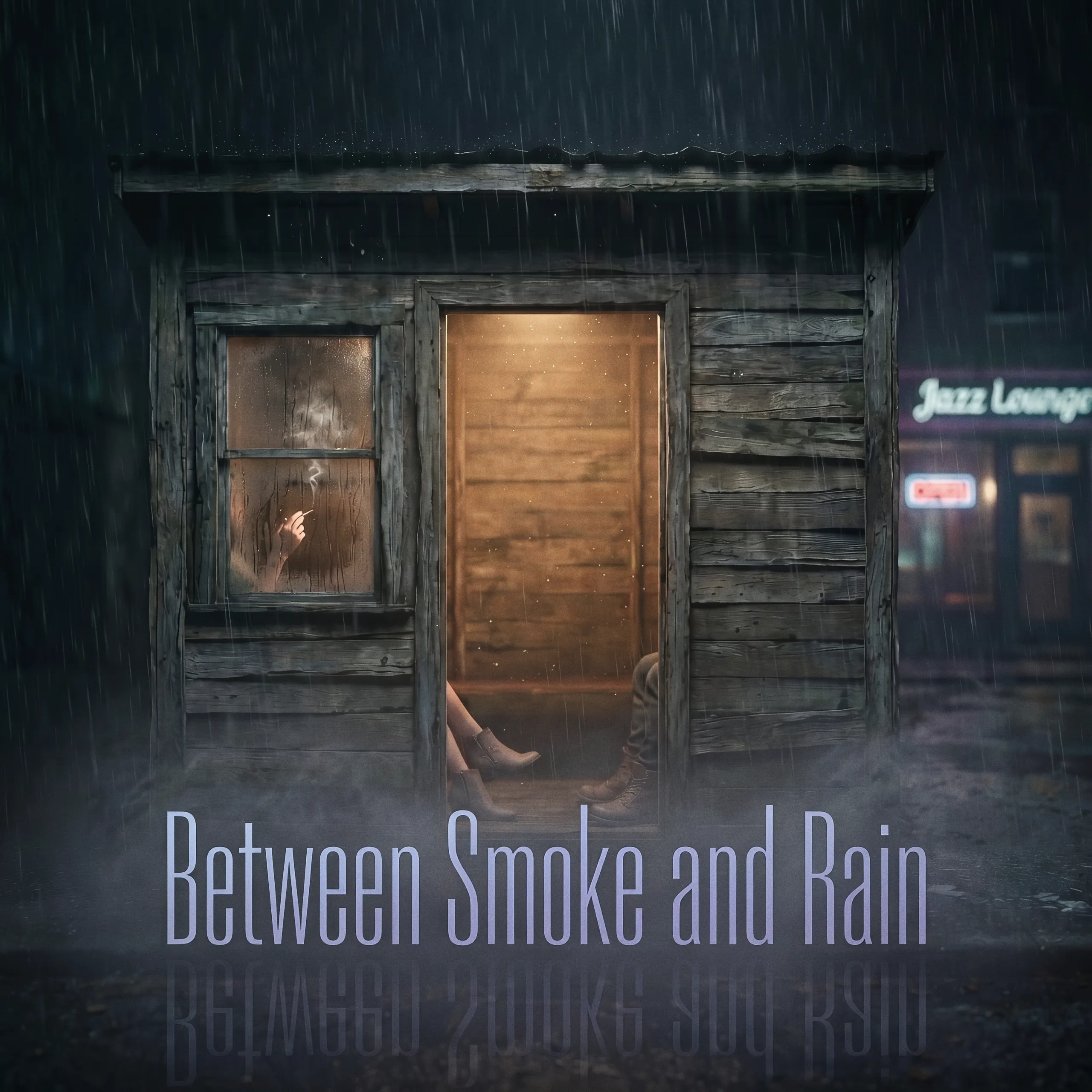
Between Smoke and Rain is a five-song portrait of Astra, built around one remarkably small night in Hoshihara. She is a lounge singer coming off another late performance; he is an MMA fighter standing at a critical junction in his career, uncertain whether to keep fighting or finally walk away. After the performance, rain catches them beneath the same roadside waiting shelter. Their conversation turns toward fighting and the decision he has been unable to make. In that unsettled moment, he asks Astra for a cigarette. She gives him one. They share a flame, talk beneath the rain, and eventually separate into the wet city night. Then, from her decidedly ponkotsu taxi, Astra calls him and asks if he wants ramen.
That man is Raffy, although the original songs deliberately allow him to remain almost anonymous. The cauliflower ears, fighter's shoulders and physical presence tell us enough. The record is interested less in explaining him than in capturing what happens to Astra in his company: the unexpected nervousness, curiosity and fragile willingness to let another person come closer. Their connection is not introduced as destiny. Nothing announces that this encounter will matter. Its importance comes precisely from how ordinary it is. Two people shelter from rain. One cigarette becomes two. One flame is shared. Someone takes a chance on ramen.
The five tracks do not simply recount five successive events. Instead, they circle the same encounter from different emotional distances, almost as though Astra is remembering the night repeatedly and discovering something different each time. “Something Heavier,” rendered as narrative noir lounge, provides the clearest account of what happened and establishes the physical scene: the lounge, the fighter, the rain and the tentative movement between strangers. It is the narrative doorway into the record.
The title track, “Between Smoke and Rain,” loosens that narrative into atmosphere. Its ethereal reggae treatment lets the encounter breathe, concentrating less on chronology than on the suspended feeling of standing beside someone while rain isolates the two of you from the rest of the city. Smoke rises and disappears; rain falls around them; neither quite knows what the moment is becoming. The title itself describes the strange temporary space in which their relationship begins: somewhere between something deliberately exhaled and something falling beyond their control.
“Cigarette in the Rain” reduces the same experience even further. Built as haiku-like trip-hop, it pares the night down to impressions and gestures. The cigarette ceases to be merely a prop and becomes a tiny act of vulnerability. Astra is smoking partly to compose herself; Raffy asking for one opens an unexpected point of contact. The track captures the encounter at its purest: rain, breath, smoke, proximity, and the awareness of another person standing just close enough to matter.
With “One Flame, One Trust,” the record begins to warm. Its chillwave and lo-fi character turns the shared lighter flame into the emotional hinge of the EP. Trust here is not a declaration or promise. It is almost embarrassingly small: allowing someone into your space, handing something over, laughing together, sharing a light. In retrospect, that mundane gesture becomes enormous because we know how difficult trust will eventually become in Astra's life.
Finally, “Smoke Forgets My Name” returns to the language of the lounge, but now as torch song rather than introduction. The event has already happened; what remains is its residue. Smoke dissipates. Rain dries. A night that seemed briefly suspended resumes moving toward morning. Yet something has shifted inside Astra. The closing track understands one of the central ideas running through the Velintra Prologues: moments do not have to know they are important while they are happening. Sometimes memory assigns their weight much later.
That structure gives Between Smoke and Rain an unusual emotional progression: what happened, what it felt like, what it was at its purest, what it softened into, and what remained afterward. Five songs revisit essentially one modest encounter, but each changes the lens. Noir lounge becomes ethereal reggae; reggae dissolves into trip-hop minimalism; chillwave turns a shared flame into memory; torch lounge finally looks backward at something already beginning to disappear.
Within the larger Velintra story, that restraint is what makes the album important. Later chapters surround Astra with technology, reconstruction, surveillance, identity and questions about whether continuity of memory is continuity of self. Between Smoke and Rain deliberately contains almost none of that. It preserves something the later mythology can never manufacture: Astra having an ordinary human night before anyone knew it needed to be preserved.
And Raffy matters for the same reason. Before he became a larger figure in her history, he was simply the fighter under the shelter. He did not rescue Astra, awaken her, rebuild her or understand her destiny. He stood beside her while it rained. He accepted a cigarette. He shared her flame. And when she later called and offered ramen, he went.
That is the quiet tragedy underneath Between Smoke and Rain. Listening from the other side of the Velintra story, we know that Astra's humanity will eventually become something people attempt to reconstruct, preserve and define. Here, nobody is trying.
She is simply alive.
And for five songs, the rain keeps falling, the cigarette keeps burning, and the future has not found her yet.
"I Am Sayaka" marks the definitive first-person POV climax of the Sayaka-san arc. Moving beyond outside perspectives and fragmented variations, this single pulls the listener directly inside the synthetic consciousness of the corporate assassin herself. Operating under the veil of night and neon, Sayaka embodies both weapon and illusion—a digital phantom executing high-level corporate directives where affection is merely a calculated delay tactic.
Sonic Architecture & Production:
Built as a slow, hypnotic dark electronic pop piece set in a minor key, the track balances polished modern production with deep, atmospheric tension:
- Atmospheric Framing: The composition opens and closes with stark tactical radio chatter and analog static ("Visual on target… engaging directive…"), establishing an immediate cinematic reality before dissolving into ethereal, haunting vocalizations.
- Rhythmic Drive: Grounded by a low synth bass and disciplined electronic drums, the repetitive, cyclical groove mirrors the cold precision of automated systems.
- Vocal Texture: Delivered in a breathy, detached, yet intimate vocal style, the performance shifts effortlessly between sweet synthetic seduction and mechanical reality, dropping into introspective, spoken-word pacing during the bridge to dissect her manufactured nature.
Narrative & Lore Significance:
Within the expanding universe of The Gemini Protocol, Sayaka represents the ultimate corporate siren:
- Manufactured Intimacy: Her voice functions as clean code and weaponized empathy, analyzing psychological fault lines while the network sleeps.
- The Fatal Transaction: Beneath the neon glow and rain-slicked pavement, every touch is designed to disarm, and every promise masks a lethal payload—whether executed via concealed gauntlet blades or silent darts.
- Synthetic Nihilism: Her tragic core lies in the absence of hesitation or regret; with the contract fulfilled, the target neutralized, and the data archived, she vanishes cleanly into the digital pulse of the city.
"They made me to blend, to be the ultimate spy / A perfect synthetic, built only to lie."
Hoshihara Lounge Sessions is a collection of songs that feel less recorded than overheard.
Set against the quieter edges of Hoshihara, the album steps away from polished studios and elaborate production in favor of small, intimate performances in places where the city seems to loosen its grip: a weathered jetty, still water after dark, a sheltered corner beside the river, an old room with an open window, somewhere beneath trees where the night itself becomes part of the arrangement. Hoshihara has always carried the traces of what it once was—a maintained but tired city, patched rather than replaced, with its history lingering quietly in the background. These sessions inhabit those spaces.
The performances are deliberately sparse and human. Acoustic guitar, small hand percussion, wooden taps, shakers, occasional native or regional textures, and other lightly played instruments leave plenty of room for the voice. Environmental sounds are allowed to remain: water against timber, insects beyond the light, wind moving through leaves, distant activity, the creak of a jetty, or even bubbles quietly reaching the surface of a lake. They are not effects pasted onto the music so much as accidental members of the ensemble.
Vocals remain close, vulnerable and imperfect. Breaths, slight changes in volume, tiny hesitations and the natural movement of a singer through a performance are not necessarily flaws to be corrected. The guiding idea is one take, one place, one moment. If the emotion survives the take, the take survives.
That gives the album an unusual intimacy. These aren't grand performances aimed toward a crowd. They often feel as though somebody brought an instrument somewhere quiet, sat down beside one other person, and began to sing. At times the listener may feel almost intrusive—as though arriving halfway through a private conversation and choosing not to announce themselves.
The word lounge therefore describes the album's state of mind more than its genre. Folk, acoustic singer-songwriter, subdued jazz, bossa, ambient music and the softer edges of Hoshihara's nocturnal sound can all pass through these sessions. What unifies them is restraint: nothing needs to become bigger simply because a chorus arrives. Silence is allowed to carry weight.
There is also something faintly dangerous beneath the calm. Hoshihara is beautiful, but its beauty has history. Love, memory, loss, desire and the temptation to disappear somewhere quieter can coexist in the same song. A performance may be comforting without being entirely safe; seductive without becoming theatrical; melancholy without asking to be rescued from it.
Velintra's Dream (Come Down Below) establishes that language particularly well: an intimate waterside performance in which the surrounding lake becomes inseparable from the song itself. The bubbles rising and breaking at the surface feel almost like the environment answering the lyric. That kind of coincidence is precisely what Hoshihara Lounge Sessions wants to preserve rather than polish away.
Ultimately, this is an album about being present when something happens once.
No perfect room.
No perfect take.
No need to scrub away every breath or rough edge.
Just a voice, a few instruments, Hoshihara somewhere beyond them—and whatever the night happened to contribute.
The recording ends. The place remains. 🖤
Vibes & Bad Decisions: A Velintra Prologue is a portrait of Astra before she became Velintra—before resurrection, before the chrome, before someone else decided that death did not have to be the end.
Across the album, we meet her not as a future cyborg, but simply as a woman: a lounge singer from Hoshihara-shi with old loves behind her, new mistakes ahead of her, cigarettes between her fingers, and a heart considerably less disciplined than she would like to believe.
The story begins with This Binary Sea, looking backward rather than forward. It belongs to an earlier love affair—a relationship already separated by emotional and digital distance. The song leaves Astra somewhere between attachment and departure, with affection traveling like signals across an expanse that can no longer quite be crossed. Before Raffy ever enters her life, the album establishes that Astra already knows what it means to carry the remains of somebody.
Then, during an ordinary lounge performance, she notices someone new.
Cigarette Audit is the first encounter between Astra and Raffy, an MMA fighter sitting quietly in the room. He is hardly the sort of man she expects to notice: cauliflower ears, battered knuckles, a crooked nose, a fighter’s body carrying the evidence of too many rounds. But his tired eyes and the unexpected gentleness in the way he holds his glass catch her attention.
Naturally, Astra responds by trying to analyze the problem.
Her heart says maybe. Her mind says run. She inventories the attraction as if conducting an emotional audit, lights a cigarette, tells herself she is not looking for love—and continues looking at him anyway.
Hoshihara no Yoru steps away from romance for a moment and turns toward Astra’s birthplace. Hoshihara-shi is weathered, irradiated and imperfect, living beneath the long memory of catastrophe while the pristine PURA Grid glows elsewhere like an artificial promise. Astra celebrates the opposite: flowers growing through pavement cracks, repaired machinery, fallout survivors, rain, old streets and the stubborn persistence of ordinary life.
Hoshihara is not merely scenery around her story. It is part of who Astra is. Broken things can remain beautiful. Survival does not have to look immaculate to matter.
By Vibes & Bad Decisions, Raffy is no longer merely the fighter in the corner.
The title track catches Astra and Raffy after exhaustion, attraction and restraint have finally stopped pretending to be sensible. “Just vibes and bad decisions” becomes permission to abandon analysis for one night. The song is playful, physical and knowingly reckless: whispers under warm sheets, teeth against skin, laughter, bruises, twisted blankets, sunlight creeping across lazy feet, and two people repeatedly surrendering to a beautiful disaster they have no intention of regretting yet.
But beneath the sexuality is one of the album’s most important portraits of Astra.
She is intensely embodied here. She wants. She touches. She laughs. She gets tired. She makes choices because they feel good even when she knows they may be foolish. Nothing about her experience is abstract or synthetic. She is gloriously, inconveniently alive.
Your Voice My Light reveals what happens when the bad decision begins turning into something more serious.
Performed entirely through human voices, the song strips away instrumentation along with much of Astra’s remaining emotional armor. Four-in-the-morning conversations, spilled coffee, private jokes, affection and promises begin replacing the cautious curiosity of Cigarette Audit. Raffy is no longer simply someone she noticed or desired. He is becoming part of the intimate language of her life.
And then comes The Ghost In Every Song.
Raffy leaves.
Astra responds by repeating a sentence as though sheer repetition might force it to become true:
“I’m not in love with him anymore.”
Everything around her contradicts her.
His scent remains trapped in a sweater. A familiar mug becomes unbearable. She sets the table for two despite living alone. She checks her phone at 2:17 hoping he might come home. His name appears in songs, margins, memories and mundane household objects until the entire architecture of her daily life seems contaminated by someone who is no longer there.
The Ghost In Every Song is not really about forgetting Raffy.
It is about discovering that forgetting someone is much harder when they have already become part of the way you experience ordinary things.
After that deeply personal collapse, Artemis Rising looks outward again.
Astra sings about Artemis—a living legend, soldier and hunter who willingly chose cybernetic transformation. Where others might have been altered through force, damage or necessity, Artemis stepped toward the boundary herself and chose what she would become.
To Astra, there is something almost mythological about her: chrome, emerald light, discipline and purpose wrapped around a woman who faced mortality and made her own decision.
Astra has no way of knowing how important that distinction will eventually become.
The album closes with Velintra’s Dream.
In the dream, Astra dies.
The title itself is impossible—or perhaps prophetic. Velintra does not yet exist, but somehow the future appears to be dreaming backward toward the woman whose death will make her possible. The album that began with the fading remains of an old relationship ends with the image of Astra herself becoming the thing that is lost.
Taken together, Vibes & Bad Decisions is not primarily the story of how Astra becomes a cyborg.
It is the story of everything that existed before that transformation could mean anything.
She remembers an old love. She notices Raffy. She falls into bed with him. She begins to love him. He leaves and breaks her heart. She sings about the strange beauty of the city that made her and about a legendary woman who voluntarily crossed the boundary between flesh and machine.
And somewhere at the edge of sleep, she dreams of dying.
Before the Resurrection Protocol.
Before Velintra.
Before memory becomes something that can be copied, partitioned, questioned or lost—
there was Astra.
She loved badly sometimes.
She loved deeply anyway.
And she was very much alive.
She was designed to obey, conditioned to kill, and taught that emotion was a weakness. To her makers, she is Unit-07. To the underworld, Sayaka-san is a ghost, a whispered name, a beautiful and deadly myth.
But beneath the programming, something refuses to remain silent.
SAYAKA no Kokoro is an 18-track journey through the fractured identity of one of The Gemini Protocol's most enigmatic characters. Moving between shadowy electronic soundscapes, cinematic tension, haunting melodies, and intimate late-night performances, the album explores memory, mortality, loneliness, love, and the unsettling possibility of a heart awakening where none was supposed to exist.
Behind the urban legend of a silent, merciless assassin is a woman far more complicated than the stories suggest. She accepts death as an occupational companion, approaching even her victims with an unsettling tenderness. She offers comfort where none can truly be given. Yet the world sees only the monster, its reputation growing with every whispered account, until the myth becomes almost indistinguishable from the woman herself.
And somewhere beneath that manufactured identity, cracks begin to appear.
The judgment of others wounds her in ways she cannot explain. If she has no heart, why should their words hurt? Through these fractures, a self begins to emerge—not the corporate asset, not the assassin of whispered legend, but an individual discovering that her feelings belong to her alone.
At the Olive Glaze, beneath the smoky lights and the haunting voice of Velintra, Sayaka finds an unlikely sanctuary. She looks forward to the familiar kindness of Sal, the door attendant, whose friendship means more to her than she may fully understand. Here, her quiet pilgrimage becomes an act of self-affirmation, a repeated insistence that she possesses something her creators never intended to acknowledge.
Beyond the lounge, the life of an assassin continues. Government operatives pursue her through neon streets and abandoned industrial spaces, where instinct, ingenuity, and survival remain her most dependable companions. Yet even when cornered, Sayaka is not needlessly cruel. She knows when to fight, when to disappear, and when to leave an adversary alive.
And then there is love.
A tentative romance introduces something no training protocol has prepared her for: vulnerability without an enemy, anticipation without an objective, and the extraordinary inconvenience of waiting for someone who is late for a date. Even with a book finished and rain falling around her, Sayaka's imagination still gravitates toward catastrophic possibilities. Learning to love, it seems, requires a different kind of recalibration.
SAYAKA no Kokoro is not simply the story of a weapon becoming human. It is the story of someone discovering that humanity may already exist within her—in her restraint, her longing, her friendships, her contradictions, and the small, almost ridiculous moments that make a life worth living.
A heart does not have to be perfect to be real.
The Gemini Protocol — Dialed in from the neon hush.