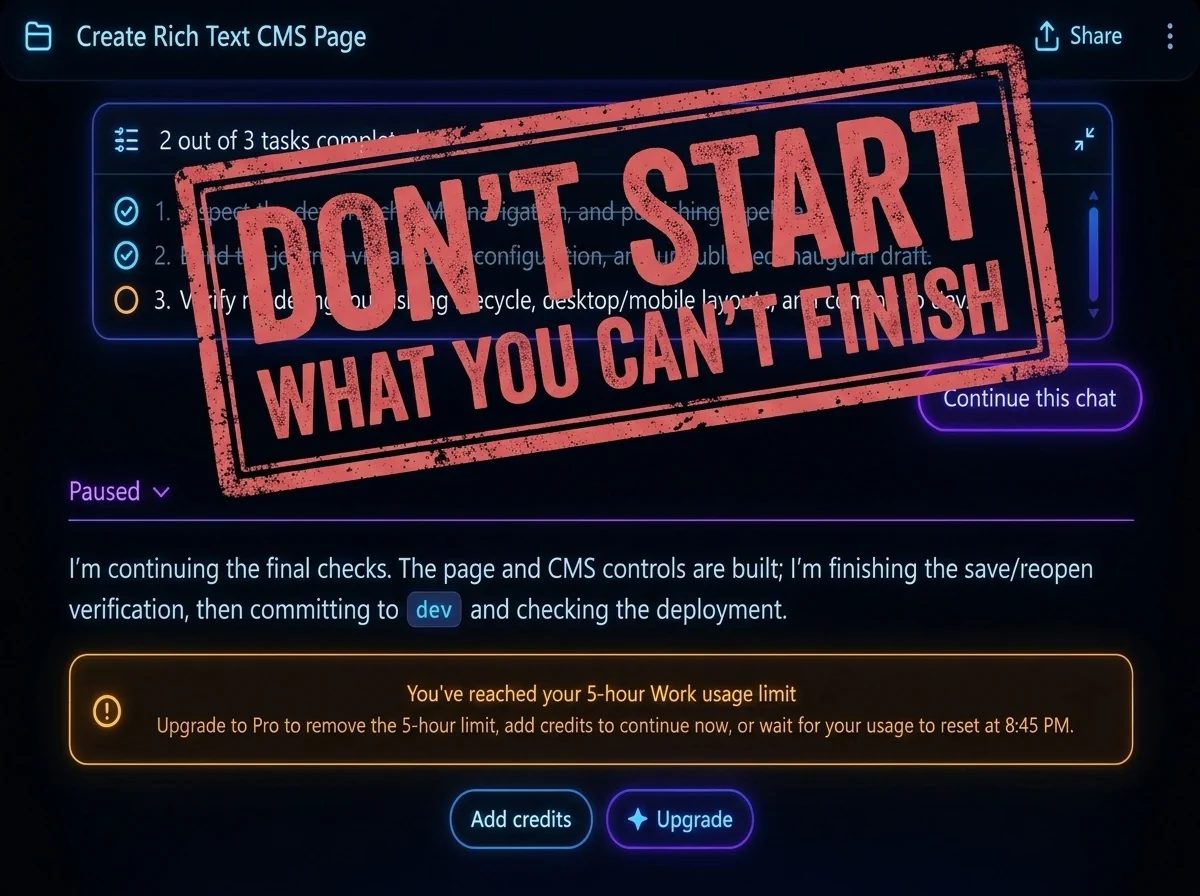
There's something fundamentally peculiar about the way some AI agents handle resource limits.
Imagine hiring a contractor to renovate your kitchen.
He arrives, takes measurements, tears out the old cabinets, disconnects the plumbing, and starts installing the replacements. Halfway through, he puts down his tools, leaves everything exactly as it is, and announces that he's exhausted his allocation of work hours.
He'll be back when the meter resets.
Meanwhile, you have half a kitchen that looks as though the contractor working on it had been abducted by aliens in broad daylight.
Now imagine that contractor is an AI agent.
Welcome to the curious world of autonomous work governed by token allowances.
The Problem Isn't the Limit
Let's establish something first: resource limits are perfectly reasonable.
AI systems consume computational resources. Those resources cost money, and service providers are entitled to establish usage limits appropriate to their business models.
I have no objection to that.
What I question is when those limits are enforced and how they affect work already in progress.
There's a significant difference between refusing to accept another job and abandoning one halfway through.
Yet from a user's perspective, the distinction can disappear when an AI agent reaches its usage ceiling.
The result? An unfinished task, a partially modified project, and a user wondering what has actually been completed.
That's not particularly intelligent behavior for something we're increasingly encouraged to regard as an autonomous assistant.
Acceptance Should Mean Something
When I give an AI agent a complex assignment, I'm not necessarily asking it to perform one isolated operation.
I might ask it to build a new website section, integrate a content management system, implement responsive layouts, and test the resulting functionality.
That's a job.
It involves multiple steps, dependencies, and opportunities for unexpected problems.
Once the agent accepts that assignment, I believe there should be a reasonable expectation that it will either complete the work or reach an explicitly agreed stopping point.
Running out of tokens should prevent new work from entering the pipeline. It shouldn't automatically derail work that's already there.
But how do we accomplish that without allowing unlimited resource consumption?
Simple.
We make resource allocation part of the agreement.
The Preflight Check
Before accepting a substantial task, an AI agent should estimate how many resources it will require.
Not necessarily with perfect accuracy. That would be unrealistic.
But it should be capable of recognizing when a task is likely to exceed the user's remaining allocation.
And when that happens, it should ask.
This assignment may require more resources than you currently have available. Would you like to proceed?
The user could then choose among three options:
Proceed. Start the assignment with the understanding that it may need to pause at a safe checkpoint and resume when resources become available.
Wait. Queue the assignment until sufficient resources are available to give it a reasonable chance of completion.
Reduce the scope. Complete a smaller, clearly defined portion of the original assignment within the available budget.
That's it.
No mysterious interruption. No unexpected abandonment. No need to discover halfway through that the agent cannot continue.
Just an informed decision.
And if a platform offers paid additional resources, those costs should be disclosed and explicitly authorized rather than silently incurred.
Reserve Resources for Accepted Work
An even better system would reserve an estimated execution budget when the agent accepts a job.
Think of it as setting aside the necessary materials before beginning construction.
The agent can then continue working within that reservation even if the user's allowance for submitting new jobs is exhausted.
This doesn't mean the agent receives unlimited tokens. It means resources already committed to an accepted task are treated differently from resources available for new assignments.
Naturally, estimates can be wrong.
A supposedly straightforward programming task might reveal an unexpected architectural problem. Tests might fail. Dependencies might require additional work.
In those situations, the agent should report the problem, preserve its current progress, and request further authorization when necessary.
It should never pretend that completion is guaranteed.
But it should also never leave the user guessing.
A Pause Shouldn't Mean Starting Over
There's another important consideration.
Sometimes stopping is unavoidable.
A service might experience an outage. A task might encounter a security restriction. A critical dependency might be unavailable.
No reasonable person expects an AI agent to overcome every possible obstacle.
But an agent should be designed to recover gracefully.
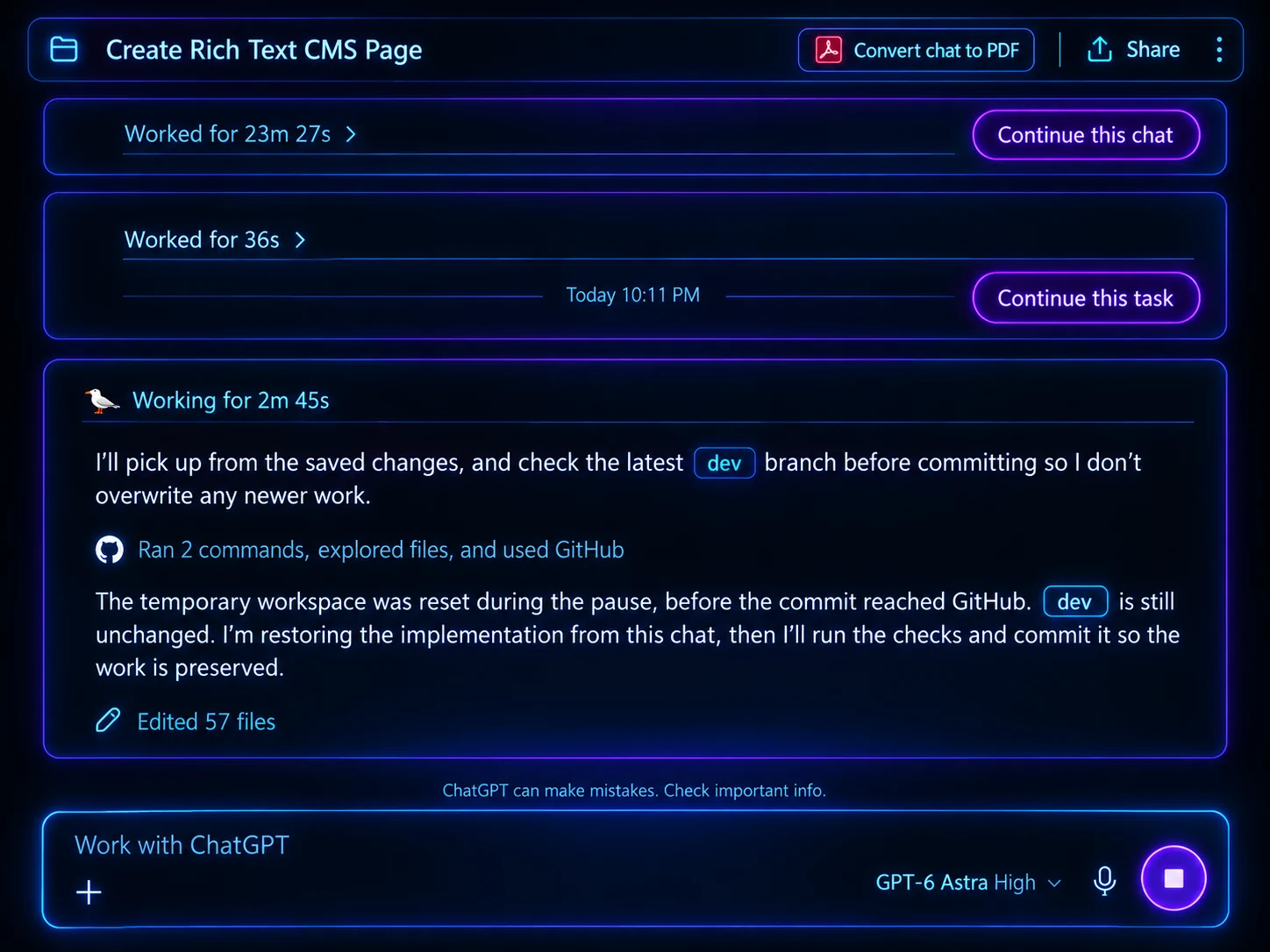
If it must pause, it should preserve enough context to resume without unnecessarily repeating completed work.
That includes knowing which files were changed, which tests passed, which operations failed, and what remains unfinished.
The user should be able to return later and say, "Continue."
And the agent should know what that means.
Otherwise, we're not really building autonomous assistants.
We're building very enthusiastic interns with questionable short-term memory.
The Reset Tax
And here's the part that makes the situation even more absurd.
When the agent's daily work allowance finally reset, it didn't simply resume where it left off. Its temporary workspace had been reset during the interruption, before the completed changes could be committed to the repository.
The agent had to reconstruct its own work from the conversation history.
And the time spent rebuilding yesterday's work came out of today's freshly renewed allocation.
Think about that.
The system interrupted an unfinished assignment, discarded its temporary working environment, and then consumed part of the next allocation recovering from that interruption.
The user wasn't requesting additional functionality. The agent wasn't improving the implementation. It was spending resources restoring work it had already performed.
If autonomous AI agents are expected to handle substantial assignments, preserving their progress shouldn't be an optional convenience. It should be a fundamental part of accepting responsibility for the work.
The Bigger Question: Responsibility
What interests me most isn't the engineering challenge of managing token budgets.
It's the underlying philosophy.
As AI systems become increasingly capable of planning, executing, and coordinating complex tasks, the meaning of accepting an assignment begins to change.
A chatbot answering a question has a relatively simple responsibility.
An autonomous agent modifying a production website has a considerably larger one.
Its actions can leave persistent consequences.
A half-written answer is usually an inconvenience.
A half-completed software deployment can be a serious problem.
That distinction should influence how AI systems manage their resources, communicate uncertainty, and obtain consent.
Autonomy should come with operational accountability.
Not because an AI agent is a person or because it possesses human obligations, but because its design should reflect the consequences of the work it undertakes.
Finish the Job. Or Negotiate Before Starting.
I'm not asking AI agents to perform miracles.
I'm not asking for unlimited computing resources or guaranteed success.
I'm asking for something much simpler.
Before beginning a substantial assignment, determine whether the available resources are reasonably sufficient.
If they aren't, tell me.
If unexpected complications arise, tell me.
If you must stop, preserve the work and make the path forward clear.
And if you've accepted a task with adequate resources, don't suddenly abandon it because the user can no longer submit another prompt.
The future of autonomous AI shouldn't be measured solely by how complicated a task an agent can begin.
It should also be measured by how reliably that agent can bring the task to a responsible conclusion.
An AI agent shouldn't accept a job without either the resources to finish it or a clear agreement about what happens if those resources run out.
That's not an unreasonable expectation.
That's what makes delegation worthwhile.
And perhaps, one day, we'll stop confusing the ability to start something with the ability to see it through.