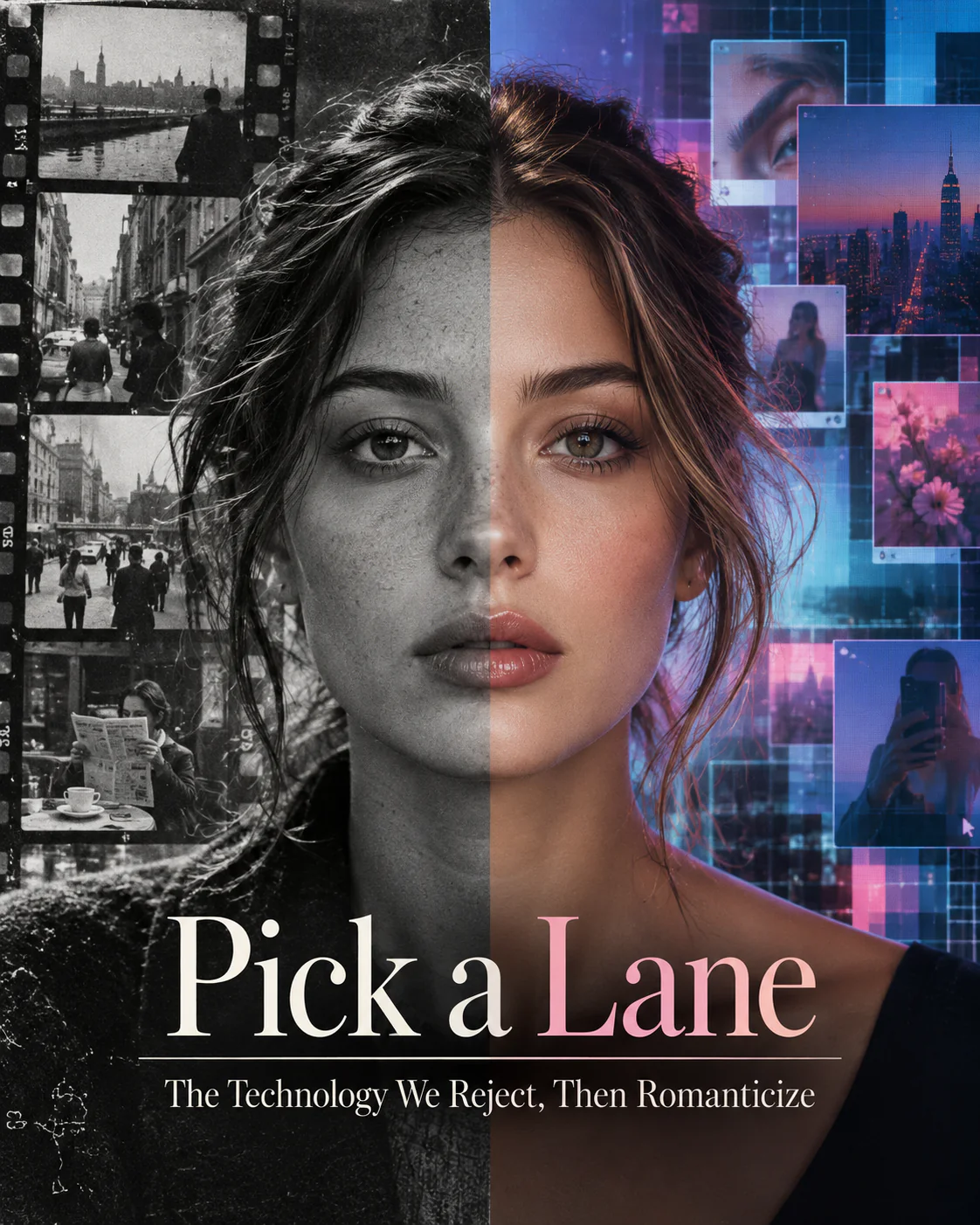
There is something wonderfully inconsistent about photographers.
For generations, camera and film manufacturers worked to eliminate the limitations of photography. They pursued finer grain, sharper lenses, more accurate color, faster film, better metering, autofocus, stabilization, greater dynamic range, cleaner high-ISO images, and eventually sensors capable of producing photographs earlier generations could barely have imagined.
We got what we wanted.
Then we opened Photoshop and put the defects back.
We add grain. We soften highlights. We introduce halation. We crush blacks. We shift colors away from accuracy. We vignette perfectly corrected lenses. We buy digital cameras capable of extraordinary technical precision and then select film simulations designed to make their output resemble photographs produced seventy years ago.
Apparently perfection has terrible vibes.
The Machine Was Always There
Arguments about AI-generated imagery often revolve around authorship.
You didn't paint that. The AI did.
There is a meaningful question buried inside that statement. Generative AI can perform an extraordinary amount of the visual interpretation that once required direct human execution. That changes the relationship between artist and tool, and it is reasonable to ask how much human direction constitutes authorship.
But the boundary becomes surprisingly difficult to draw.
Years ago, I used a program called FotoSketcher. Give it a photograph, select a painting or drawing effect, adjust some parameters, and the software transformed the photograph.
I never particularly liked the results.
They usually looked exactly like what they were: photographs processed to resemble paintings. The software could reproduce surface characteristics—brush-like textures, pencil edges, paper grain—but it didn't seem to understand what it was depicting.
...wait, that's not entirely true. I did enjoy the results, though I eventually learned that the effect usually had to be pushed further than seemed natural. If I kept the settings too subtle, the image often still looked unmistakably photographic—just slightly woozy, as though the original photograph had enjoyed a few too many shots of gin.
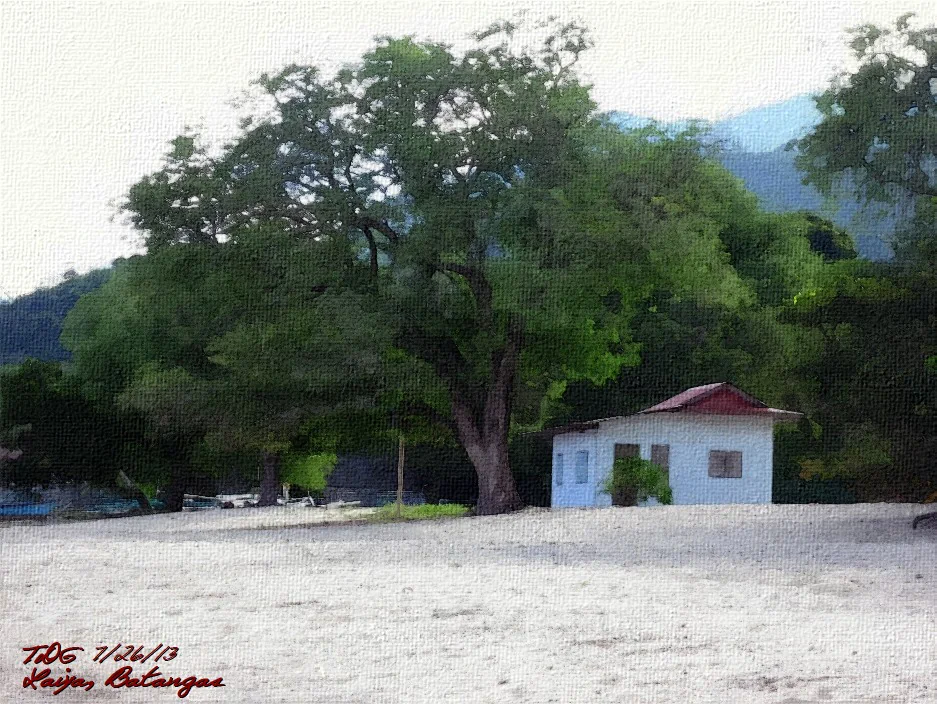
Exaggerate the treatment enough, though, and FotoSketcher could produce something genuinely fun and visually convincing. Even then, the transformation was largely stylistic: brush-like textures, pencil edges, paper grain. The software could imitate the surface language of another medium, but it didn't really seem to understand what it was depicting.
Still, I wasn't painting those images.
An algorithm written by somebody else was doing much of the transformation.
Nobody had yet put the letters AI on the argument.
“But You Photoshopped It”
Photography has been negotiating this question almost since photography existed.
A photographer working decades ago could choose film stock, exposure, developer, development time, enlarger settings, photographic paper, contrast, and printing technique. Images could be cropped, dodged, burned, retouched, composited, or otherwise manipulated.
The darkroom was not a sacred chamber where objective photons entered one side and Truth emerged from the other.
It was Photoshop with a terrible Undo function.
Yet when digital photography and image editors became commonplace, another boundary appeared:
But you Photoshopped it.
As though manipulation had suddenly been invented.
Today we can use Photoshop to simulate a photograph from the 1940s.
We carefully add grain that film manufacturers spent decades trying to reduce.
We reproduce optical imperfections that lens designers worked to eliminate.
We introduce softness into images captured by extraordinarily sharp modern lenses.
We deliberately distort color produced by cameras engineered for accuracy.
The technological defect becomes an aesthetic feature once we are no longer forced to live with it.
Noise is undesirable.
Grain has character.
A missed focus is a mistake.
Softness is dreamy.
Incorrect color is a technical problem.
A color grade is cinematic.
Pick a lane.
Then AI Walked Into the Darkroom
Generative AI makes the argument harder because it doesn't merely process pixels according to a fixed transformation.
It can interpret.
Ask a generative system to transform a photograph into a painting and, at its best, it doesn't simply place a brush texture over the original pixels.

It can reconstruct shapes, simplify detail, reinterpret light, change edges, and produce visual decisions resembling those associated with another medium.
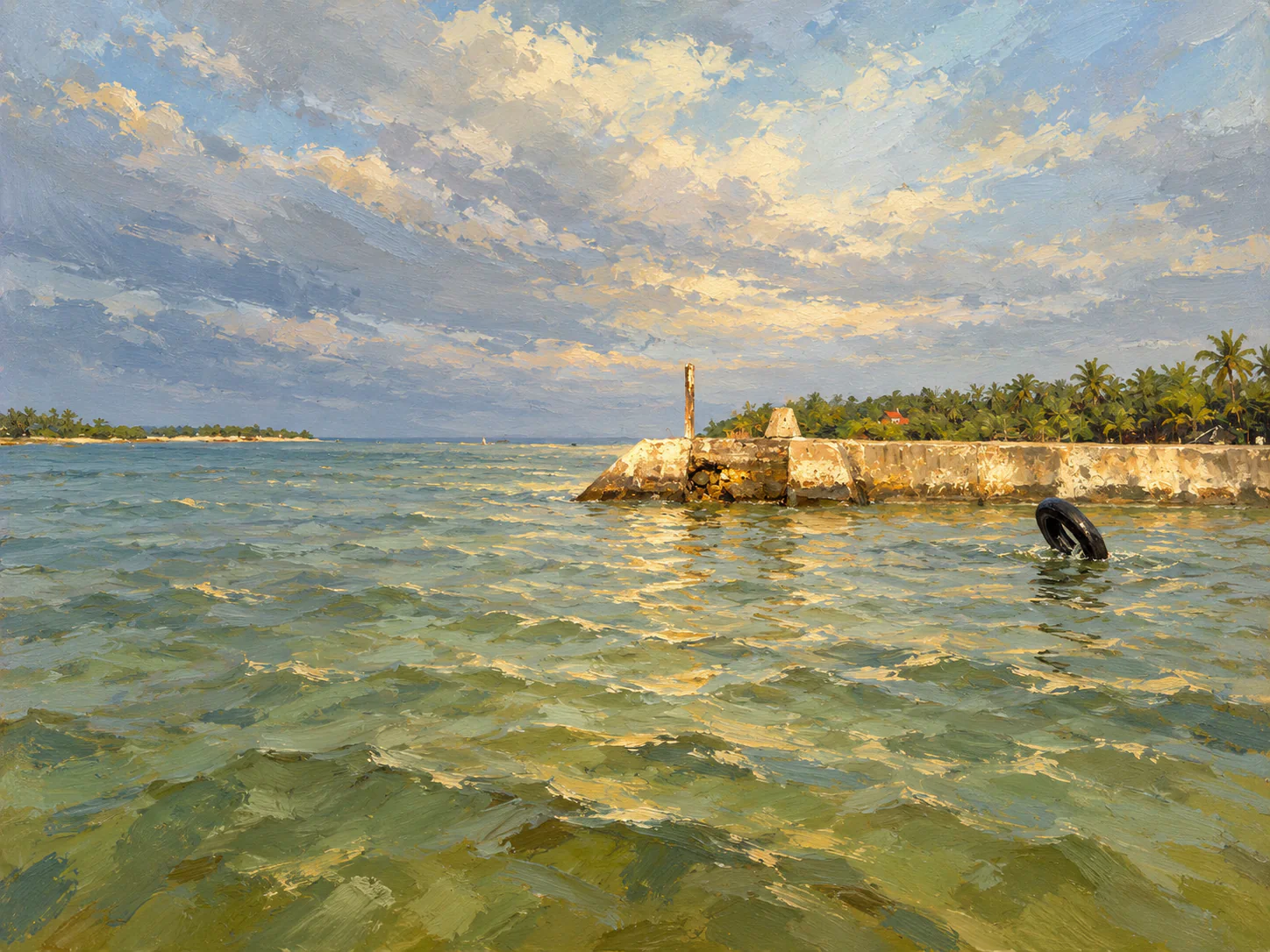
That is considerably different from selecting Oil Painting 7 and moving three sliders.
The distinction matters.
But difference does not automatically establish a clean boundary between tool and creator.
Modern cameras already perform astonishing amounts of computation. Autofocus algorithms help determine focus. Metering systems evaluate exposure. Firmware processes sensor information. RAW software demosaics data that never existed as ordinary RGB pixels on the sensor. Phones may combine multiple exposures before the photographer ever sees the photograph.
We still generally attribute the photograph to the photographer.
Why?
Because authorship has never required personally performing every mechanical or mathematical operation involved in producing an image.
The photographer chooses.
Frames.
Waits.
Rejects.
Recognizes.
One time, on the way to Tondol Beach, he saw the light falling across a salt farm, stopped the car, and forgot where he was headed because dammit, look at that light.
The machinery changes.
The instinct is strangely persistent.
What Are We Actually Protecting?
That may be the more interesting question behind resistance to new creative technologies.
Perhaps we are not protecting a particular process.
Perhaps we are protecting the value we associate with human intention.
That is a legitimate thing to care about.
A documentary photograph carries different expectations from an illustration. A photograph submitted to a competition may operate under rules defining acceptable manipulation. Journalism requires disclosure and fidelity that fantasy artwork does not. A hand-painted canvas represents a kind of physical labor that entering a prompt clearly does not.
Different processes deserve different descriptions.
But acknowledging those distinctions does not require pretending that creativity has historically consisted of an unaided human performing every step.
Humans build tools precisely because we don't want to perform every step.
The interesting part is deciding which steps we delegate and which decisions we keep.
And that boundary has never stopped moving.
We Keep Moving the Line
Perhaps AI feels uniquely disruptive because the machine is now participating in territory we previously considered unmistakably ours: interpretation, composition, language, style, imagination.
That deserves serious examination.
But history should make us cautious about declaring that the latest technological boundary happens to be the permanent definition of authentic creativity.
Photography itself once challenged that definition.
Digital photography challenged it again.
Photoshop challenged it again.
Computational photography quietly moved it further.
Now generative AI has kicked the door open and dragged the argument into another room.
Meanwhile, photographers equipped with cameras of astonishing technical capability are deliberately recreating grain, softness, flare, faded colors and optical imperfections from technologies their predecessors spent enormous effort trying to escape.
There is something deeply human about that.
We invent technology to overcome our limitations.
Then we become nostalgic for the limitations.
Then we invent newer technology to recreate them.
And finally we argue about whether using the newer technology is cheating.
We spent a century teaching cameras to stop making mistakes.
Then we taught software to put the mistakes back.
Now we're arguing about whether the software is allowed to be creative.
Pick a lane.