
There's a particular kind of madness reserved for people who create music with generative AI.
It begins innocently enough.
You've just produced a song. It's beautiful. The arrangement is exquisite, the vocals are astonishing, and somewhere in the second chorus, the AI has done something you never explicitly asked it to do—something so musically appropriate, so emotionally precise, that you wonder whether the machine has developed an appreciation for beauty.
It's great... and extremely rare.
Most of the time, these little Suno gems are one-offs—moments you may never hear again, no matter how many times you attempt to reproduce them.
You're delighted.
There's just one little problem.
The intro.
Something about the intro bothers you. Maybe a phrase sounds awkward. Maybe the singer takes an unnecessary liberty with the melody. Maybe there's a vocal flourish you'd rather not have. Or, the words just plain don't make sense, and you just can't let it go.
In my case, Suno had improvised a little harmony near the end of the intro to a song called Git Out of My Branch.
It sang:
"Clone that repo my branch."
Apparently, it was trying to echo the opening line of Verse 1:
"Cloned that repo, got the dev branch hot."
Musically, the idea wasn't necessarily bad. A little lyrical callback before the verse begins? Clever, even.
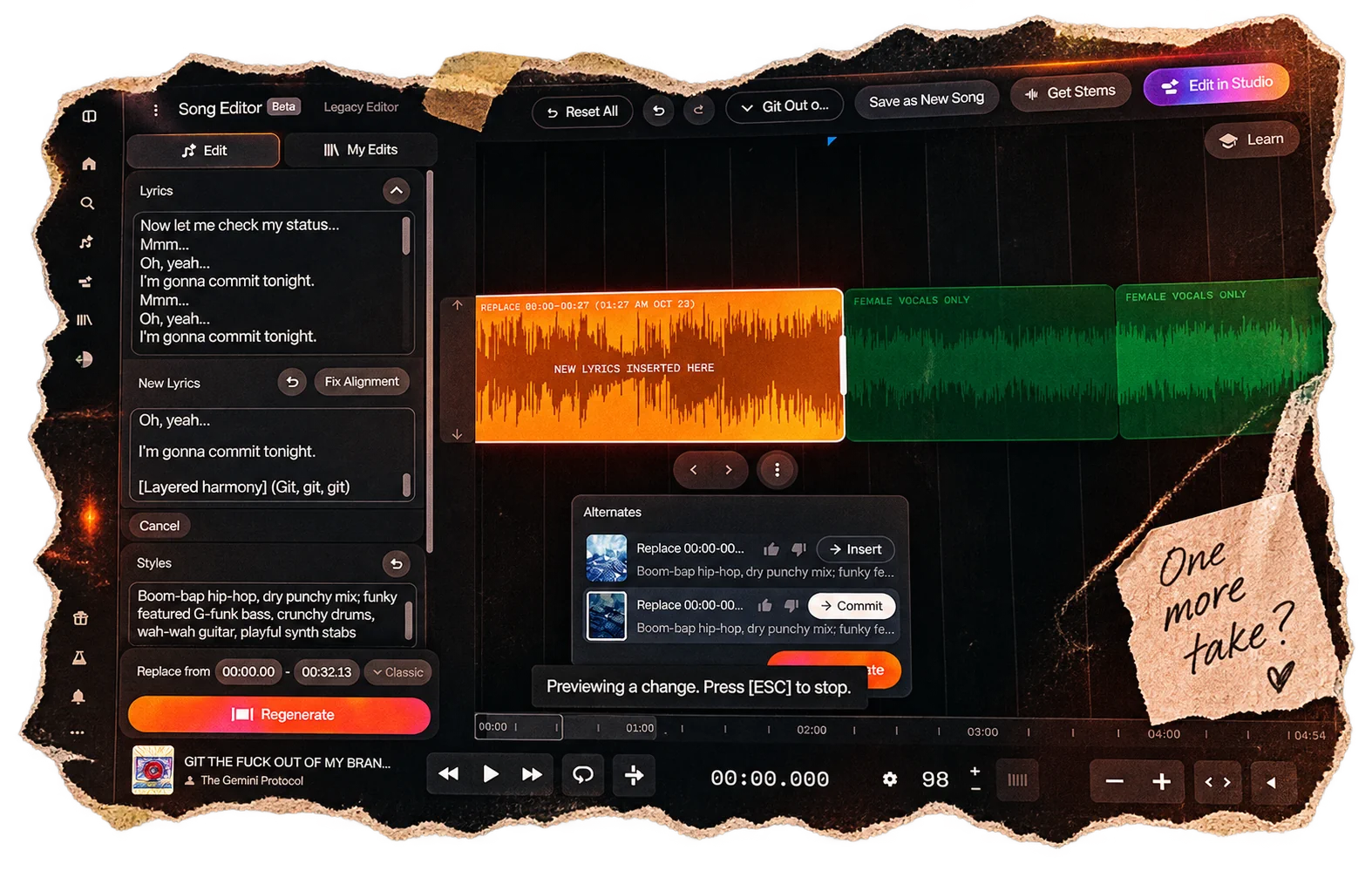
Except the words didn't make any sense.
And once I'd noticed them, I couldn't unhear them.
All I wanted was to correct that one little harmony.
No problem. Suno has a Replace feature.
You select the intro, make your adjustments, and click Generate.
The machine obliges.
It replaces the intro.
And, as an unexpected bonus, it replaces the first two lines of Verse 1 with the ending of the intro.
Fucking marvelous.
{{< journal-divider >}}
Welcome to the Casino
Naturally, you try again.
Perhaps your selection was too long. Perhaps it was too short. Perhaps the lyrics weren't sufficiently clear. Maybe the transition boundary needs adjusting.
You change something.
Generate.
Nope.
You change something else.
Generate.
Almost.
Ah. Almost.
That is where the trouble begins.
Because the previous result was closer, wasn't it? Clearly you're beginning to understand how the machine interprets your instructions. You're narrowing down the variables. Another adjustment should do it.
Generate.
This time, the intro is beautiful, but the singer has apparently forgotten where Verse 1 begins.
Generate.
Now the verse begins correctly, but the intro sounds like it belongs to an entirely different song.
Generate.
Twenty credits later, you're no closer to your objective.
Somewhere inside Suno's servers, imaginary casino bells are ringing.
And you're staring at the Generate button, thinking: "I KNOW THERE'S A GEM SOMEWHERE IN THERE. SPIT IT OUT!"
{{< journal-divider >}}
The Cruelty of Occasional Perfection
Here's what makes this particularly interesting.
The rewards are real.
Generative music systems can produce genuinely extraordinary performances. Sometimes the voice lands on precisely the right emotional inflection. Sometimes a melody emerges that feels inevitable, as though no other sequence of notes could possibly belong there.
Sometimes an AI singer delivers a line with such breathtaking sensitivity that you forget, momentarily, how the performance came into existence.
These aren't imaginary victories.
They're the reason we keep coming back.
And they're also why failures become so difficult to accept.
When you've already heard what the system is capable of, every disappointing generation feels less like a limitation and more like an extraordinary performance that simply hasn't come out yet.
The masterpiece exists somewhere in the possibility space.
You just haven't found it.
[[もう一回 | Mou ikkai | One more time]]
That's the psychological trap.
The machine doesn't need to promise you perfection. It has already demonstrated that perfection—or something tantalizingly close to it—is possible.
And sometimes, that's all the encouragement you need.
{{< journal-divider >}}
The Engineer Meets the Slot Machine
There's another layer to this predicament.
People accustomed to technical problem-solving naturally approach these systems as engineering challenges.
We identify the problem. Isolate variables. Change parameters. Observe outcomes. Refine our methods.
This is how we debug software.
This is how we troubleshoot complex systems.
And initially, it's how we expect to work with generative AI.
If a particular instruction produces a desirable result, we assume we've discovered a useful technique.
We repeat it.
Sometimes it works.
Wonderful! We've cracked the code.
We document the procedure, confidently explain our discovery to fellow creators, and congratulate ourselves on having finally understood the machine.
Then we apply the same technique to the next song.
And Suno responds as though we've just asked it to perform open-heart surgery with a trombone.
Our triumph evaporates.
What happened?
The uncomfortable answer is that we may have mistaken a favorable outcome for a reproducible method.
Generative AI is probabilistic. Identical or nearly identical inputs need not produce identical outputs. Instructions can influence results without rigidly determining them.
That doesn't mean careful prompting is useless.
It means prompting is not the same as programming.
And a successful generation is not proof that we've discovered a reliable procedure.
{{< journal-divider >}}
An Imperfection of Technology—or a Business Model?
This brings us to a rather uncomfortable question.
Is this frustrating unpredictability simply a consequence of our imperfect understanding and implementation of generative AI?
Or are we witnessing a business model that benefits from precisely that unpredictability?
The first explanation is technically plausible.
Generating an entirely new song and precisely modifying an existing recording are fundamentally different challenges.
The former gives the model freedom to invent.
The latter demands fidelity—to the original melody, arrangement, vocal character, timing, and everything outside the intended edit.
A system can be extraordinarily capable at one and frustratingly unreliable at the other.
But the second question deserves attention, too.
Suno operates with a credit-based generation system. Each additional attempt may consume more of a user's available credits.
That creates an interesting economic relationship.
A successful generation delivers value to the customer.
An unsuccessful generation may also generate revenue for the company, provided the customer continues purchasing credits.
And a generation that's almost successful?
That might be the most commercially interesting outcome of all.
To be clear, there is no basis here for claiming Suno deliberately sabotages generations or manipulates results to extract more payments.
Such an accusation would require evidence.
But we don't need a conspiracy to recognize a structural tension.
A company doesn't have to intentionally create an imperfection to benefit financially from its existence.
And when users repeatedly pay for unsuccessful attempts to correct flaws, the distinction between creative experimentation and paid troubleshooting becomes increasingly blurred.
Imagine if your word processor charged you every time its Find and Replace function changed the wrong sentence.
You'd have questions.
Quite a few of them, actually.
{{< journal-divider >}}
The Most Expensive Word in AI Music
The real danger isn't necessarily the first disappointing generation.
It's the nearly successful one.
When a result is completely wrong, rejecting it is easy.
But when a song is 98% perfect, the remaining 2% becomes irresistible.
Surely one more attempt will fix that awkward syllable.
Surely another generation will preserve the extraordinary vocal performance while repairing the intro.
Surely the model can change one tiny thing without disturbing everything else.
And sometimes it can.
That's the maddening part.
Sometimes the gamble pays off spectacularly.
The problem is that our judgment can become distorted by the memory of those spectacular results. We start treating the next success as something we're owed, something that must be waiting just beyond the next generation.
We stop asking whether another attempt is worthwhile.
We start asking how many attempts it will take.
That's an important difference.
The most expensive word in AI music production might just be "almost."
{{< journal-divider >}}
When Does Creativity Become Compulsion?
None of this means generative music is inherently exploitative or that creators should abandon it.
Far from it.
The technology has opened remarkable creative possibilities to people who might otherwise lack the resources to produce fully arranged music.
It has also introduced new ways of experimenting with composition, instrumentation, vocal expression, and genre.
That value is genuine.
But so is the need for self-awareness.
There comes a point when another generation is no longer a meaningful creative decision. It's simply another attempt to recover the feeling of that spectacular result you once received.
And perhaps the most useful skill a generative music producer can develop isn't writing better prompts.
It's recognizing when to stop.
Maybe three unsuccessful attempts should trigger a change of approach. Maybe the solution is conventional audio editing. Maybe the original performance, despite its imperfections, is already the best version of the song.
Or maybe the mistake is worth keeping.
After all, plenty of beloved recordings contain accidents, rough edges, imperfect vocals, and moments their creators never originally intended.
Not every imperfection needs to be eradicated.
Especially when eradicating it threatens to destroy everything beautiful surrounding it.
{{< journal-divider >}}
One More Spin?
I eventually tried something different.
Instead of repeatedly regenerating the same intro, I changed the actual lyrics I didn't like and used the lyric-replacement feature.
The result appeared more promising.
For a moment, I wondered whether I'd discovered the secret.
Whether providing a concrete lyrical change was the key to making Suno respect the boundaries of the edit.
Whether, finally, I understood how to make the machine cooperate.
Then I remembered.
We've been here before.
A successful result is not a universal solution.
It may be evidence that a particular approach is useful.
Or it may simply be another favorable draw from a system whose behavior remains only partially predictable.
The distinction matters.
I still love what generative music makes possible. I've heard too many extraordinary things emerge from these systems to dismiss them.
But I've also endured too many disappointments chasing that glint in the distance.
We've all been there, haven't we?
And yet we tolerate it.
We tolerate it because we know there is perfection inside the imperfection.
And we are all about that perfection.
But I've also learned to be suspicious of my own confidence whenever I think I've finally mastered one.
Somewhere between artistic discovery, probabilistic computation, and commercial incentives, we've created an extraordinary new instrument.
One that can produce astonishing beauty.
One that occasionally refuses to perform the simplest correction.
And one that always seems to have a button inviting us to try again: "Come on, one more time? Let's go!"
The song is almost perfect.
The credits are running low.
The machine is ready.
And somewhere in the back of my mind, a familiar little voice whispers back:
"Yeah, let's go. Just one more."
{{< journal-divider >}}
The Gemini Protocol — Perspectives
Dialed in from the neon hush.